

Quick answer
A McLaren forged wheel project starts with verified fitment data for the exact model and year, then checks carbon-ceramic brake clearance, staggered sizing, lug hardware, low ride height and TPMS. Low mass and finish quality drive design and construction choices. After drawing approval and a test-fit sample, MOQ, timing and Incoterms are confirmed in a written quotation.
McLaren owners are demanding wheel customers. They expect very low weight, precise fitment and finish quality that matches a hand-built supercar. Many also take their cars to track days, so a wheel must look exceptional and still work with large brakes, aggressive tires and low ride heights.
This checklist is for tuning shops, supercar specialists and wheel brands planning a forged McLaren project, whether it is a single custom set or a small branded range. It covers the data to collect, the engineering checks we run, construction and finish choices, and the approval steps that keep supercar projects on track.
Step 1: Define the Exact Car and Use
McLaren builds several model lines, and wheel fitment, brake packages and body width can differ between them and between updates. The first step is to define exactly which models and model years the wheels are for, and how they will be used.
- Model, model year and market for each target car.
- Whether the car has optional carbon-ceramic or upgraded brakes.
- Street, mixed or track use, and planned tire types.
- Whether the customer uses a front-axle lift system.
- Single custom set or a small production range.
Projects for one owner can be highly individual, while a branded range needs designs that work across several cars. Decide which you are building before the design work begins, because it changes SKU planning and the quotation.
Step 2: Collect and Verify Fitment Data
We do not publish bolt patterns, offsets, center bores or tire sizes for specific McLaren models. Every project is engineered from your fitment sheet or OEM data, which we verify before drawing approval. On supercar projects, measurements taken from the actual car are valuable, especially if it has non-standard parts.
| Parameter | Why it matters on a McLaren |
|---|---|
| PCD and lug seat | Must match the car’s lug bolts and seat type |
| Center bore | Hub-centric fit for precise mounting |
| Offset and width | Clearance with wide tires and bodywork |
| Brake clearance | Large calipers need careful spoke design |
| Front and rear sizes | Staggered setups are typical |
| TPMS | Sensor fit and valve position |
Our wheel offset calculator helps compare a proposed width and offset with the factory setup.
Step 3: Check Brake and Caliper Clearance
Brake clearance is the most common failure point on supercar wheel projects. Large calipers, especially with carbon-ceramic systems, leave little space between the caliper and the inside of the spokes. Concave faces make this harder, because the spokes curve inward toward the caliper.
To avoid problems, send caliper drawings or a brake clearance template with your RFQ. We model the spoke back side against the caliper profile in the drawing, and the sample test fit confirms the result on the car. If the desired concavity does not clear the brakes at a given size, we will tell you before production and suggest options such as a different face profile or width. Our guide to forged wheel concavity and spoke design explains the trade-offs.
Step 4: Choose Construction and Weight Targets
Weight matters on a McLaren more than on most cars. A forged monoblock usually gives the lowest mass and the cleanest look, and it is the common choice for track-oriented customers. Multi-piece wheels offer more lip and face combinations for show builds, but add hardware and assembly steps.
- Forged monoblock for track use and lowest part count.
- 2-piece forged for more face and lip variety on street cars.
- 3-piece forged for fully custom show builds.
Set realistic weight targets in the brief, but remember that strength comes first. Load capacity is calculated for each design and size from the vehicle data; we do not quote generic ratings. Our Lamborghini and Ferrari forged wheel checklist covers similar supercar decisions.
Step 5: Specify Finish and Details
Finish quality is visible on every McLaren. Common choices include satin and gloss paints, brushed faces with tinted or clear coats, two-tone designs, polished lips on multi-piece wheels and custom colors matched to the car or its accents. Track customers often choose satin finishes that are easier to clean after brake dust and rubber build-up.
Custom colors should always be approved on a physical sample rather than a screen image, because the wheel surface and clear coat change how a color looks.
Details make a difference at this level: hardware finish on multi-piece wheels, center cap style, valve stem color and logo placement. Every detail is shown on the drawing and confirmed on the sample. For private-label ranges, we can add your logo on caps, spokes or lips and supply branded packaging suitable for high-value products.
Step 6: Read and Approve the Drawing
The technical drawing is where a supercar project is won or lost. It shows diameter, width, offset, PCD, center bore, lug seat, brake clearance profile, face profile, finish areas and logo positions. Review every value against your data before you approve it.
If you are new to reviewing wheel drawings, our guide on how to read a forged wheel drawing and spec sheet explains each field. Ask questions at this stage rather than after production, because changes are simple on paper and expensive on finished wheels.
Pay special attention to three areas on supercar drawings: the brake clearance line, the front and rear offset values for staggered sets, and the lug seat specification. These are the most common sources of fitment problems. If anything on the car has been modified, such as spacers, aftermarket brakes or lowered suspension, note it on the drawing so the final wheel matches the car as it is actually built.
Step 7: Sample, Test Fit and Production
After drawing approval, a sample is produced for test fitting. On a McLaren, the test fit should cover brake clearance, suspension clearance at full lock, fender clearance with the planned tires and the look of the finish in daylight. Approve the sample before mass production begins.
MOQ is confirmed per project and depends on design, size, SKU count, finish and packaging. Production timing, shipping route and Incoterms are confirmed in the written quotation. High-value wheels also need careful packaging to avoid finish damage in transit, so tell us your packaging requirements early.
Vehicle names are used for fitment reference only; we are not affiliated with the manufacturers.
Request a Quote for McLaren Forged Wheels
If you are planning a McLaren wheel project, send your fitment data, brake details, design references and quantities. Browse our forged wheel products for construction examples, then use the request a quote form, email or WhatsApp. We will review fitment, prepare the drawing and confirm MOQ, timing and Incoterms in writing.
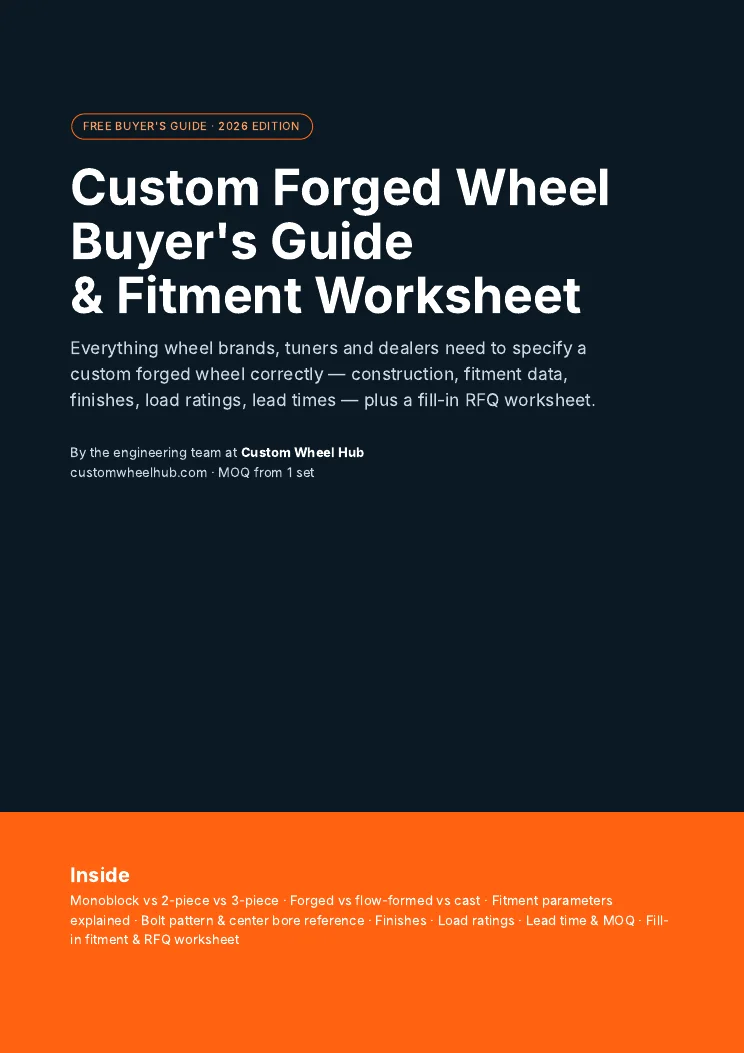
Free PDF: Custom Forged Wheel Buyer’s Guide & Fitment Worksheet
Construction, fitment parameters, bolt pattern table, finishes, load ratings and a fill-in RFQ worksheet.
Download Free GuideFrequently Asked Questions
Can you make a single custom set for one McLaren?
Single custom sets can be discussed, but MOQ is confirmed per project and depends on design, size, finish and packaging. Fully custom one-off wheels involve the same drawing, sample and approval steps as a larger order, which is reflected in the written quotation.
How do you handle carbon-ceramic brake clearance?
We ask for caliper drawings or a clearance template and model the spoke back side against the caliper in the drawing. The sample test fit confirms clearance on the car. If a design or concavity level does not clear at a certain size, we flag it before production.
Which construction is best for a track-focused McLaren?
A forged monoblock is the usual choice because it keeps mass and part count low. The final decision depends on tire sizes, brake package and styling goals. We review your brief and recommend a construction before the technical drawing is prepared.
Do you publish McLaren bolt pattern and offset data?
No. Fitment values vary by model, year and market, so we engineer from your fitment sheet, OEM data or measurements from the car. We verify the data before drawing approval, and the test-fit sample confirms the result before production starts.
What should a McLaren wheel RFQ include?
Include the model, year and market, fitment data, brake details, front and rear sizes, construction, finish references, logo files, packaging needs and quantities. We review the information, prepare a drawing and reply with a written quotation confirming MOQ, production timing, shipping route and Incoterms.
Get a quick forged wheel quote
Send your vehicle platform, wheel size, PCD, offset, finish and quantity. We confirm fitment and reply within 24 hours.