Quick answer
Custom forged wheels for the GR Supra and GR86 should be built from verified fitment data for each platform, because the two cars do not share hub, brake or body geometry. Buyers supply PCD, offset, center bore, width, diameter and caliper clearance; the factory confirms the drawing, approves a sample and quotes MOQ, timing and Incoterms in writing.
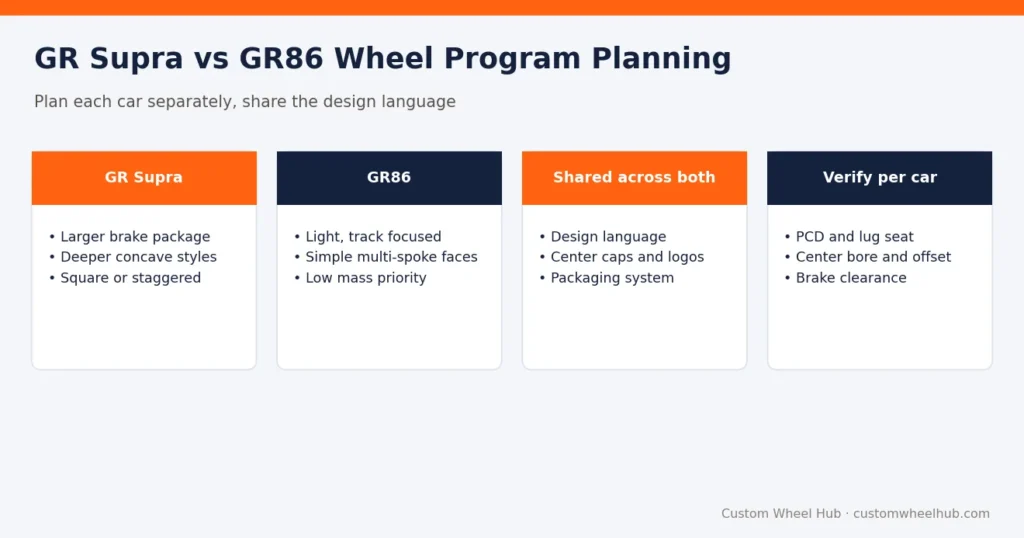
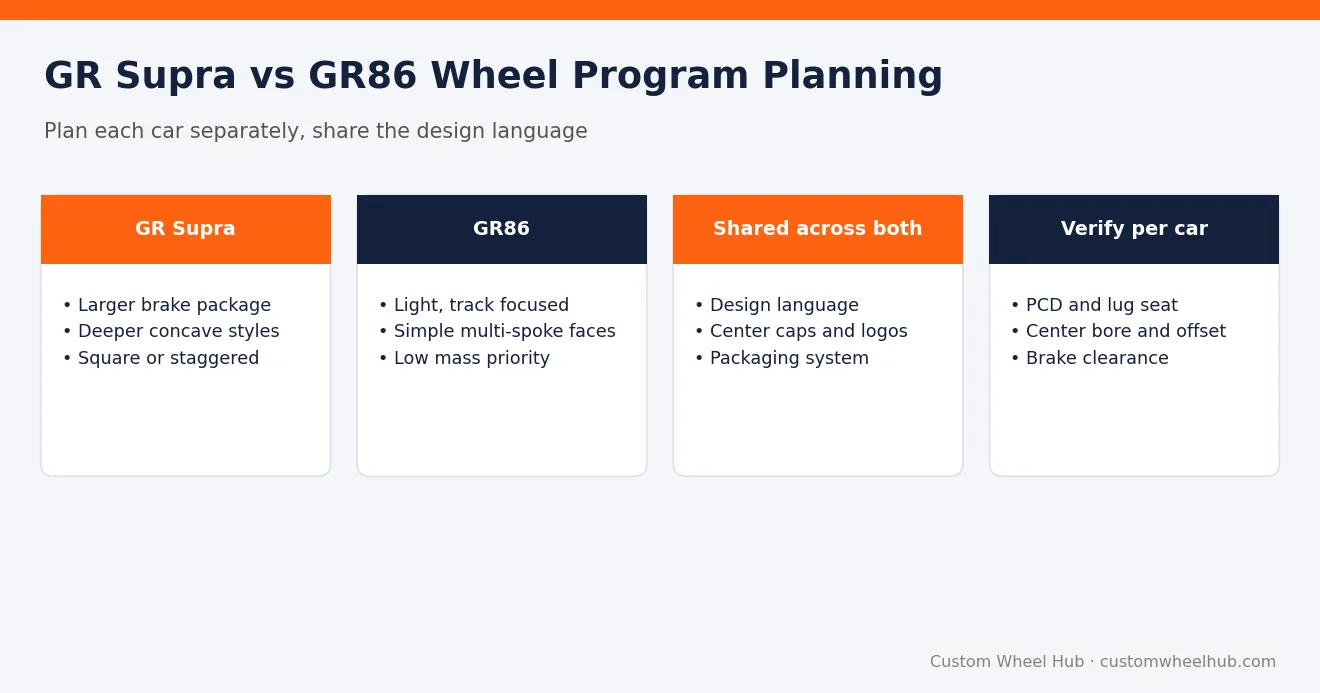
The Toyota GR Supra and GR86 sit under the same GR badge, but they are different cars from a wheel engineering point of view. One is a turbocharged grand tourer with a large brake package; the other is a light, naturally aspirated coupe that owners take to autocross and track days. Treating them as one SKU family is the fastest way to create fitment returns.
This guide is written for wheel brands, distributors and tuning shops planning a forged wheel line for either car. It covers the fitment parameters that matter, construction options, track and street use, finishes, MOQ planning and the steps from RFQ to approved sample.
Why the GR Supra and GR86 Need Separate Wheel Programs
The two cars were developed with different partners and on different platforms. The current GR Supra shares much of its chassis with a European sports car, while the GR86 is a joint project with another Japanese manufacturer. As a result, hub dimensions, lug hardware, brake packages and wheel well space differ between them.
For a wheel brand this means two separate drawings, two sets of fitment validation and usually two packaging and labeling sets. A design language can be shared across both cars, so a spoke style that sells on the Supra can be adapted for the GR86, but the engineering behind each wheel should be checked against the correct vehicle data. If you also sell into the European platform that shares parts with the Supra, our BMW forged wheel fitment guide explains related hub and hardware questions.
Fitment Parameters That Matter on These Platforms
We do not publish bolt patterns, offsets or center bores for specific model years, because they vary by market, trim and update. Instead, every project starts from the buyer’s fitment sheet or OEM data, which we verify before drawing approval. The parameters we review are:
- PCD and lug seat type: the Supra and GR86 use different lug hardware, so the seat type must match the bolts or nuts the customer will use.
- Center bore: hub-centric fit reduces vibration complaints; hub rings are an option when one wheel serves several cars.
- Offset and width: these decide whether the wheel clears struts, fenders and suspension arms with the planned tire.
- Brake clearance: caliper profile and any big brake kit must be checked against the spoke back side.
- Staggered or square setup: decide early, because it doubles or halves your SKU count.
Our wheel offset calculator helps compare a proposed size with the stock wheel before you send an RFQ.
Choosing Monoblock, 2-Piece or 3-Piece Construction
Most GR86 buyers care about low mass and a clean look, so a forged monoblock is the usual starting point. Supra customers often want deeper lips or more aggressive faces, which can push some brands toward 2-piece or 3-piece construction. The table below summarizes how we discuss the options with buyers.
| Construction | Typical fit for this program | Planning note |
|---|---|---|
| Forged monoblock | GR86 track and street, Supra street | Lowest part count, simplest finishing |
| 2-piece forged | Supra show and street builds | More face and lip combinations per size |
| 3-piece forged | Low-volume custom orders | Most flexibility, more assembly steps |
| Cast alloy | Volume replica or entry lines | Tooling cost spread over larger runs |
Construction affects weight, cost and finishing options, so confirm it before design work starts.
Track Use, Weight and Brake Cooling
Both cars attract owners who drive on track, and that changes what a wheel brand should ask for. A track-focused wheel usually needs more brake clearance, a spoke shape that lets heat escape and a design that keeps weight low without thinning areas that carry load. Load capacity is calculated for each design and size from the vehicle data you provide; we do not quote generic load ratings.
Points to put in your brief:
- Whether the wheel is sold for street, mixed or dedicated track use.
- Which brake kits your customers commonly fit, with caliper drawings if available.
- Target tire widths, so rim width and offset can be set together.
- Whether a lighter, simpler face is preferred over deep concave styling.
If your market requires a specific wheel standard, tell us at the RFQ stage so testing can be planned.
Design, Concavity and Finish Choices
Supra buyers tend to choose larger diameters with strong concavity, while GR86 owners often prefer simple, lightweight multi-spoke designs. Concavity is limited by offset and brake clearance, so the deepest face is not always possible on every size. Our guide to forged wheel concavity and spoke design explains how face depth, spoke count and offset interact.
Finish options we commonly discuss include gloss or satin paint, brushed and clear coated faces, machined accents, two-tone combinations and polished lips on multi-piece wheels. For track-oriented lines, durable satin colors are easier to maintain than highly polished surfaces. Branding can include custom center caps, engraved or laser-etched logos and private-label packaging, all approved on the drawing before production.
Building a SKU Plan for a GR Line
A GR-focused wheel line can grow quickly if every color, size and offset becomes its own SKU. A practical approach is to launch with a small core range and expand once sell-through data is clear.
- Start with one or two designs per car rather than many.
- Choose two or three finishes that suit both street and track customers.
- Decide square or staggered fitment per car before quoting.
- Keep a shared center cap and logo set across both models.
MOQ is confirmed per project and depends on design, size, SKU count, finish and packaging. A tight SKU plan usually gives a more efficient quotation and makes sample approval faster.
From RFQ to Approved Sample
A clear RFQ shortens the whole process. Send the vehicle model and model years you are targeting, your fitment sheet, wheel diameter and width, construction type, finish references, logo files and estimated quantities. If you are not sure about bolt circle values, check them with our wheel PCD calculator and include the source of your data.
We then prepare a technical drawing for approval. After drawing approval, a sample can be produced for test fitting on the car, including brake and suspension clearance checks. Production timing, shipping route and Incoterms are confirmed in the written quotation, not assumed in advance. Mass production starts only after the sample and finish are approved.
Vehicle names are used for fitment reference only; we are not affiliated with the manufacturers.
Request a Quote for GR Supra and GR86 Forged Wheels
If you are planning a forged wheel line for the GR Supra, the GR86, or both, start with your fitment data and design direction. Browse our forged wheel products for construction references, then send your brief through the request a quote form, by email or on WhatsApp. We will review fitment, confirm the drawing and reply with MOQ, timing and Incoterms in a written quotation.
Frequently Asked Questions
Can one forged wheel design fit both the GR Supra and GR86?
The design language can be shared, but the wheel itself is usually engineered separately for each car. Hub dimensions, lug hardware, brake packages and wheel well space differ, so each version needs its own drawing. We verify the fitment data for each car before drawing approval and sample production.
Do you publish bolt pattern and offset data for these cars?
No. Fitment values change by market, model year and trim, so we work from your fitment sheet or OEM data and verify it during drawing review. Our offset and PCD calculators help you compare options before you send an RFQ, and a test-fit sample confirms the final result.
Which construction is best for a GR86 track wheel?
A forged monoblock is the usual choice because it keeps the part count low and allows a lightweight design. The final choice depends on your target tire width, brake kits and styling. We review these points with you and recommend a construction before the drawing is prepared.
Can you make forged wheels that clear big brake kits?
Yes, if we receive the caliper data or drawings for the kits your customers use. Brake clearance is checked on the drawing and again on the sample. Some combinations of diameter, offset and concavity will not clear larger kits, and we will flag that before production.
What information should a GR wheel RFQ include?
Include the target car and model years, fitment sheet, diameter and width per position, construction type, finish references, logo files, packaging needs and estimated quantities. With this information we can prepare a drawing and a written quotation that confirms MOQ, production timing, shipping route and Incoterms.
Get a quick forged wheel quote
Send your vehicle platform, wheel size, PCD, offset, finish and quantity. We confirm fitment and reply within 24 hours.