Quick answer
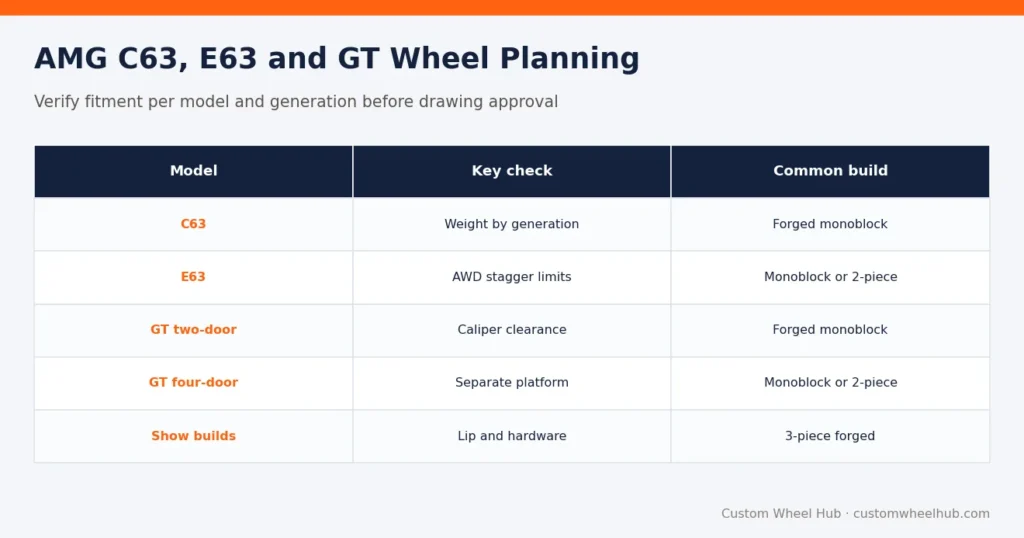
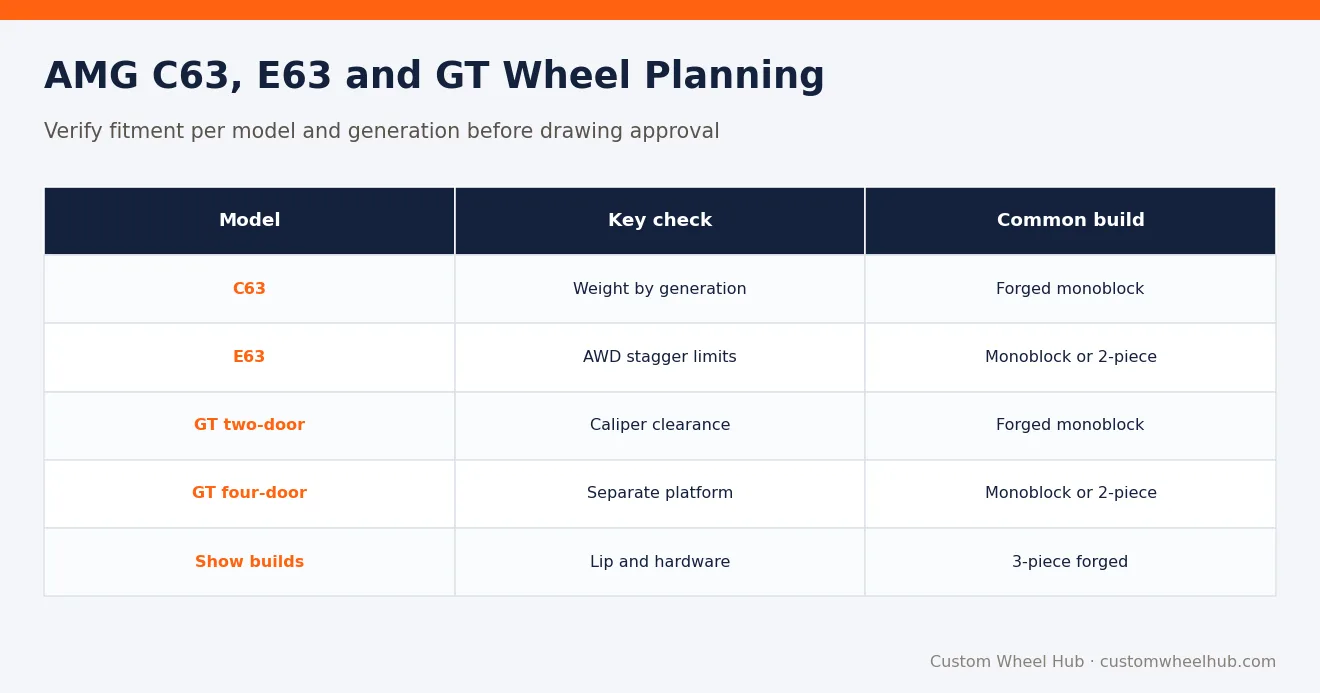
Custom forged wheels for the Mercedes-AMG C63, E63 and GT should be engineered per model and generation, because weight, brake packages, drivetrain and body width differ. Buyers send verified fitment data and sizes; the factory checks lug seat, hub-centric fit, caliper clearance, staggered sizing and TPMS, approves a drawing and sample, then confirms MOQ, timing and Incoterms in writing.
The Mercedes-AMG C63, E63 and GT are among the most popular platforms for performance forged wheels. Owners want a stronger stance, lower unsprung weight and a finish that sets their car apart, while many also drive on track. Each model line has gone through several generations with different drivetrains, brakes and weights, which makes accurate fitment planning essential.
This guide is for tuning shops, wheel brands and distributors planning a forged AMG program. It covers how to separate models and generations, the fitment data we verify, brake clearance, construction, finishes, and the steps from RFQ to approved sample.
Separate Models and Generations
The AMG badge covers very different cars. The C63 and E63 have each been offered with different engines, drivetrains and, in newer generations, hybrid systems that add weight. The GT name covers both a two-door sports car and a four-door model built on a different platform. Treating these as one program leads to fitment errors.
- List each model, generation, body style and market you plan to cover.
- Note rear-drive and all-wheel-drive versions separately.
- Record performance brake options, including carbon-ceramic packages.
- Treat hybrid versions as a separate weight and load review.
If you also sell wheels for AMG SUVs, our Mercedes-AMG G-Class forged wheel fitment guide covers that platform separately.
Fitment Parameters We Verify
We do not publish exact bolt patterns, offsets, center bores or tire sizes for specific AMG model years. Every wheel is engineered from your fitment sheet or OEM data, which we verify before drawing approval.
| Parameter | Why it matters on AMG models |
|---|---|
| PCD and lug seat | Must match the lug bolts and seat type used |
| Center bore | Hub-centric fit for smooth high-speed running |
| Offset and width | Clearance with wide tires and fenders |
| Brake clearance | Large calipers and optional ceramic brakes |
| Front and rear sizes | Staggered setups are common |
| TPMS | Sensor type and valve position |
Our center bore calculator helps when one design will be offered across several Mercedes models.
Brake Clearance and Concavity
AMG performance brake packages use large multi-piston calipers, and some cars have carbon-ceramic brakes with even larger calipers. Deep concave faces bring the spokes closer to the caliper, so the most aggressive designs may not clear every brake option at every size.
Send caliper drawings or a clearance template with your RFQ, and tell us which brake options your customers have. We model the spoke back side against the caliper on the drawing and confirm clearance with a test-fit sample. If a design does not clear, we will propose alternatives, such as a different face profile, width or diameter, before production. Our wheel offset calculator helps compare how offset changes affect spoke and fender position.
Staggered Fitment and Drivetrain
Many AMG owners run staggered setups, with wider rear wheels for traction and stance. All-wheel-drive versions need extra care, because the ratio between front and rear rolling diameter should stay within the limits the drivetrain expects. Changing tire sizes without checking this can cause drivetrain warnings or wear.
- Decide square or staggered fitment for each model.
- Check the rolling diameter of planned front and rear tires.
- Confirm tire sizes with your customers before quoting.
- Verify the combination on the test-fit sample.
Square setups allow tire rotation and simplify inventory, which some track customers prefer. Staggered setups suit street cars where stance and rear traction matter most.
Whichever approach you choose, document it clearly on product pages and packaging labels. Front and rear wheels in a staggered set should be marked by position, so installers do not swap them, and your sales team should be able to explain why a square setup may be recommended for some customers.
Construction and Weight
Forged monoblock wheels are the most common choice for AMG performance cars because they give low mass and a clean design. 2-piece forged wheels offer more lip and face combinations for show and street builds, while 3-piece wheels suit fully custom projects with polished lips and visible hardware.
Weight targets should be set in the brief, but strength comes first. Load capacity is calculated for each design and size from the vehicle data you provide, especially for heavier hybrid versions; we do not quote generic ratings. If your market requires a wheel standard such as JWL, VIA or TÜV testing, mention it at the RFQ stage so testing can be planned.
Track customers also benefit from designs that allow airflow around the brakes and from finishes that tolerate heat and brake dust. Tell us how the wheels will be used, including any track days or performance driving events, so the spoke shape, weight targets and finish all reflect real conditions rather than showroom appearance alone.
Finishes and Branding
Popular AMG finishes include satin and gloss black, gunmetal, matte grey, brushed faces with clear or tinted coats, two-tone machined designs and custom colors matched to body paint or brake calipers. Track-focused customers often choose satin finishes that are easier to clean after heavy brake dust.
Private-label buyers can add their own logo on center caps, spokes or lips and use branded packaging. We do not reproduce the vehicle maker’s logos or wheel designs; each range should use its own design language. Every finish and logo position is approved on the drawing and confirmed on a physical sample before production.
MOQ, Samples and Approval
MOQ is confirmed per project and depends on design, size, SKU count, finish and packaging. AMG programs can grow quickly across models, generations and staggered sizes, so start with a focused range for the most popular cars and expand after sell-through is clear.
The process runs from RFQ to fitment review, technical drawing, drawing approval, sample production and test fit, then mass production. On AMG cars, the test fit should cover caliper clearance, fender clearance with the planned tires and steering lock. Production timing, shipping route and Incoterms are confirmed in the written quotation.
Vehicle names are used for fitment reference only; we are not affiliated with the manufacturers.
Request a Quote for Mercedes-AMG Forged Wheels
If you are planning forged wheels for the C63, E63 or GT, send your fitment data, brake details, sizes, design direction and quantities. See our dealer and wholesale program for how we support resellers, then use the request a quote form, email or WhatsApp. We will review fitment, prepare the drawing and confirm MOQ, timing and Incoterms in writing.
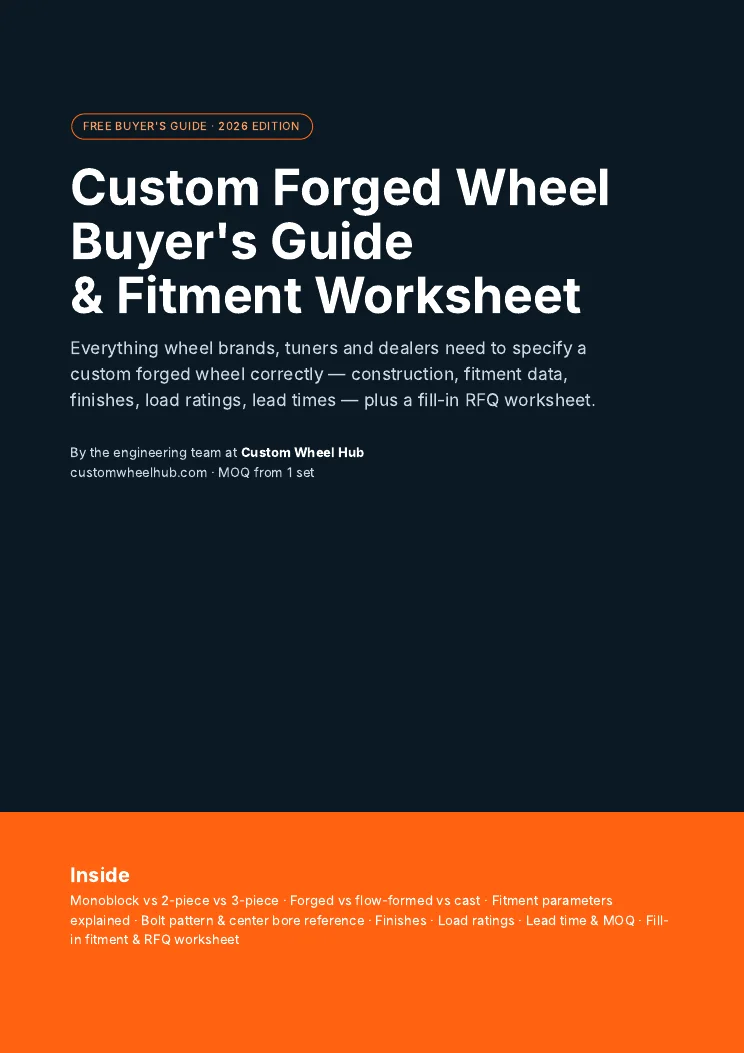
Free PDF: Custom Forged Wheel Buyer’s Guide & Fitment Worksheet
Construction, fitment parameters, bolt pattern table, finishes, load ratings and a fill-in RFQ worksheet.
Download Free GuideFrequently Asked Questions
Can one forged wheel fit the C63, E63 and GT?
Sometimes a design can be shared, but each wheel must be checked against the target model’s fitment data, brakes and body width. The two-door and four-door GT models are built on different platforms. We confirm on the drawing which vehicles a single SKU can cover.
Will your wheels clear AMG carbon-ceramic brakes?
Clearance depends on caliper size, diameter, offset and face profile. Send caliper drawings or a clearance template, and we model the spoke back side against it on the drawing. The test-fit sample confirms the result, and we flag any design that will not clear.
Is staggered fitment safe on all-wheel-drive AMG models?
Staggered setups can work, but front and rear rolling diameters must stay within the limits the drivetrain expects. We review your planned tire sizes with the fitment data and recommend checking the exact tire combination on the test-fit sample before mass production.
Do hybrid AMG models need different wheels?
Hybrid versions are heavier and can have different brakes or fitment details, so they need their own review. We calculate the required load for each design and size from the vehicle data you provide and confirm compatibility on the drawing.
What should an AMG wheel RFQ include?
Include target models, generations and markets, your fitment sheet, front and rear sizes, brake details, construction, finish references, logo files, packaging needs and quantities. We review the data, prepare a drawing and reply with a written quotation confirming MOQ, production timing, shipping route and Incoterms.
Get a quick forged wheel quote
Send your vehicle platform, wheel size, PCD, offset, finish and quantity. We confirm fitment and reply within 24 hours.