
Quick answer: A private-label forged wheel should be treated as one controlled product system: wheel design, center cap, logos, laser markings, finish, carton artwork, labels and approval records all need matching revision codes. The safest sequence is to approve the technical wheel specification first, then lock brand assets and placement, review digital proofs, approve physical samples and release production only after every customer-facing component matches the signed master.
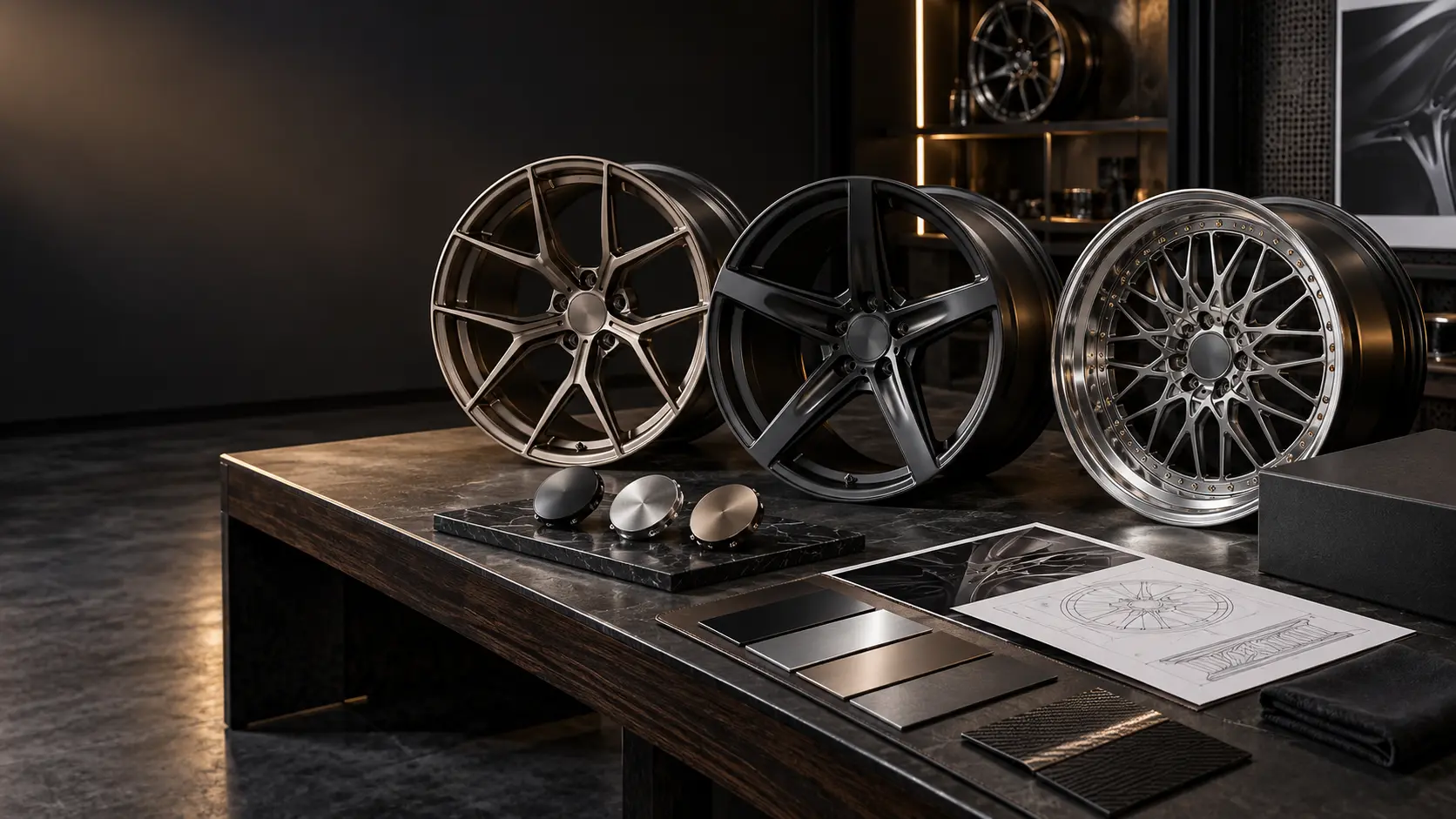
Private-Label Wheel Branding: What Can Be Customized?
| Brand element | Common options | What must be controlled |
|---|---|---|
| Center cap | Printed, engraved, embossed or dimensional logo; color-matched or contrasting finish | Cap diameter, retention system, logo orientation, color, artwork revision and service replacement |
| Wheel face | Laser-engraved wordmark, icon, model name or limited-edition number | Exact zone, size, depth/contrast, orientation and exclusion from critical surfaces |
| Back pad / barrel | Part number, load data, size, batch code, compliance or traceability marks | Legibility, required content, evidence for regulated marks and permanence |
| Valve cap / hardware | Branded cap, color-coordinated fasteners or assembly details | Material compatibility, corrosion strategy, spare-part specification and torque documentation |
| Carton | Logo, product name, handling icons, country/origin text and importer data | Dieline, print method, SKU/version, legal text, barcode and shipping durability |
| Labels and inserts | SKU label, installation notes, warranty card, care guide and QR code | Market language, destination requirements, URL ownership and document revision |
Start With a Brand Asset Pack
Send production-ready vector artwork rather than a screenshot or social-media logo. The asset pack should identify the master logo, monochrome version, minimum size, clear space, approved colors and whether the mark may be engraved, printed, embossed or altered for small applications. Include the legal company name and trademark-use instructions when the brand owner differs from the importer.
- Vector files: AI, EPS, PDF or SVG with fonts outlined or supplied.
- Color references: physical standard, Pantone reference or agreed supplier color code, plus gloss/texture.
- Logo hierarchy: master brand, wheel model, series and any co-branding rules.
- Restricted uses: minimum size, no-distortion rules and prohibited background combinations.
- Ownership: written confirmation that the buyer is authorized to use all submitted marks.
Center Caps: Small Part, High Visibility
Center caps often create more launch problems than their size suggests. A cap has to fit the wheel mechanically, present the logo at the intended orientation, survive the chosen finish process and remain replaceable after sale. Lock the cap body, retention method and logo insert before approving carton photography or product listings.
| Center-cap decision | Questions to answer before sample approval |
|---|---|
| Fit and retention | What is the cap diameter, insertion depth, clip or thread system, and removal method? |
| Brand execution | Is the logo printed, laser engraved, embossed, recessed, domed or attached as an insert? |
| Orientation | Does the logo need a fixed upright position, and can the retention system maintain it? |
| Finish match | Should the cap match the wheel exactly or use an intentional contrast? |
| Service stock | How many spare caps are required and how will replacements be identified? |
| Packaging | Are caps installed, individually protected or packed separately to avoid transport damage? |
Laser Engraving: Define Content, Location and Purpose
Separate decorative branding from technical marking. A decorative logo may sit on a spoke or rim area selected for visual balance, while part numbers, dimensions, load information and traceability usually belong in a controlled back-pad or barrel zone. The engineering team must approve every marking location so that no engraving is placed on a fastener seat, hub mounting face, sealing surface or other critical interface.
Do not add JWL, VIA, TÜV or another approval mark as decoration. A regulated or scheme-controlled mark must be supported by evidence that covers the exact wheel and authorizes its use.
Packaging: Build a System, Not Just a Printed Box
A retail carton must identify and protect the correct wheel. Design the packaging around wheel diameter, width, finish sensitivity, included accessories and freight route. The artwork should leave a controlled area for variable SKU labels so one generic brand carton does not create warehouse ambiguity.
- Outer carton artwork and print color proof
- Foam, bag, rim protector and face protection for the approved finish
- SKU label with model, size, PCD, offset, center bore, finish and quantity
- Barcode or QR structure owned by the buyer
- Country-of-origin, importer or recycling text required for the destination
- Accessory pack list: cap, valve, fasteners, tool and instructions as applicable
- Handling and stacking instructions based on the final packed weight and route
A Practical Approval Workflow
- Freeze the technical brief. Confirm vehicle/application, construction, size, PCD, offset, center bore, brake clearance, load target and finish direction.
- Issue the brand asset pack. Provide vector logos, colors, naming, legal copy and contact owner.
- Create a branding map. Mark every logo, model code, serial/batch field, label and insert on drawings or dielines.
- Review digital proofs. Check scale, spelling, orientation, safe zones, variable-data areas and revision number.
- Approve physical samples. Inspect the wheel, cap, engraving, color, carton and protection—not isolated photos only.
- Sign one master package. Link wheel drawing, finish code, artwork, cap drawing, carton dieline and label template.
- Release production. Use the same signed revision in the purchase order, QC checklist and shipping marks.
- Retain service records. Keep spare-cap and packaging references so repeat orders remain compatible.
Private-Label Branding Approval Matrix
| Item | Buyer supplies | Supplier returns | Release evidence |
|---|---|---|---|
| Wheel identity | Model name and SKU logic | Marked-up drawing | Signed drawing revision |
| Center cap | Vector logo and color | Cap rendering/sample | Signed cap sample and drawing |
| Laser marks | Content and hierarchy | Location/depth proof | Approved marking map |
| Finish | Reference and acceptance target | Panel or wheel sample | Retained master and finish code |
| Carton | Brand copy, legal text and barcode data | Dieline and print proof | Signed artwork revision |
| Labels | Variable fields and database owner | Label template/sample scan | Approved template plus test scan |
| Instructions | Destination language and policy inputs | Formatted insert | Signed document revision |
Common Errors That Delay a Launch
- Approving a wheel render before the cap retention and brake-clearance design are fixed.
- Using RGB screen colors without a physical or controlled print/finish reference.
- Changing a logo after samples while leaving old artwork on cartons or inserts.
- Treating each wheel finish as the same SKU and losing label-level traceability.
- Printing certification language before the exact document scope is confirmed.
- Ordering only four caps per set with no replacement stock or service identifier.
- Using a generic carton label that omits offset, PCD or finish and invites picking errors.
See the private-label wheel program, review the broader private-label MOQ and sample guide, and use wheel project examples to align the visual direction before artwork begins.
Frequently Asked Questions
What logo file should I send for a center cap?
Send a vector AI, EPS, PDF or SVG file with the correct master artwork and color reference. A high-resolution raster reference can help visually, but it should not be the only production file.
Can the logo be laser engraved anywhere on the wheel?
No. The location must be reviewed against structure, clamping, sealing, fastener and machining interfaces. Approve a marked drawing for the exact wheel.
Can one carton work for several sizes and finishes?
It can if protection and dimensions are suitable and a controlled variable label clearly identifies every SKU. Confirm this during the packaging sample review.
When should branding be finalized?
Lock the technical wheel direction first, then approve brand artwork and physical samples before production release. Late artwork changes can affect caps, markings, cartons, labels and photography together.
Build a Private-Label Branding Pack
Send your vector logo, wheel direction, target sizes, finish references, center-cap concept, carton requirements, destination market, quantity per SKU and target launch window. We can map the items that need drawings, proofs and samples before quotation is finalized.