
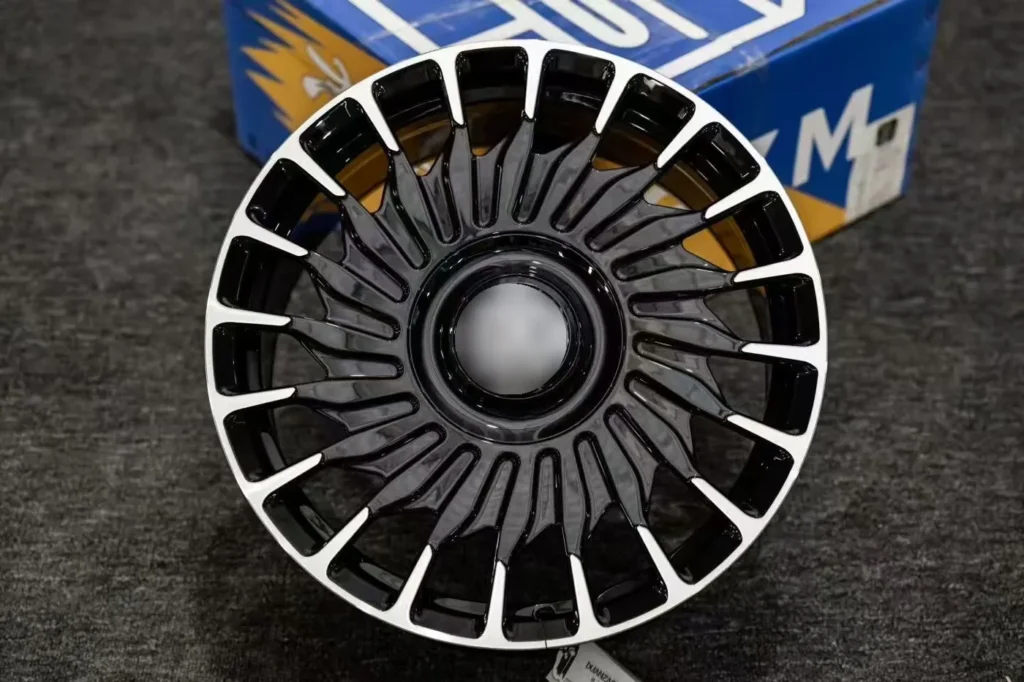
Quick answer
A staggered wheel setup uses wider wheels, and usually wider tires, on the rear axle than on the front. A square setup uses the same wheel and tire size at all four corners. Staggered setups add rear grip and an aggressive stance, mainly on rear-wheel-drive cars. Square setups allow tire rotation, wear more evenly and suit most AWD and daily-driven cars.
“Staggered or square?” is one of the first questions anyone asks when planning new wheels. The answer shapes how the car looks, how it puts power down, how long the tires last and how much the setup costs to run over time.
This guide explains what each setup means, where staggered fitment genuinely helps and where it simply adds expense. It covers tire rotation, rear-wheel-drive and all-wheel-drive considerations, and the measurements you need before asking a factory to build a custom forged set. By the end you should know which layout fits your car and how you plan to use it.
Staggered vs Square at a Glance
How the two wheel layouts compare on grip, wear, rotation and looks
| Factor | Staggered | Square |
|---|---|---|
| Rear grip | Higher on RWD | Balanced |
| Tire rotation | Limited | Full rotation |
| Tire wear | Rears wear faster | Even wear |
| Best for | Powerful RWD cars | AWD, FWD, daily use |
| Look | Wide rear stance | Uniform, clean |
What Is a Staggered Wheel Setup?
A staggered setup means the front and rear wheels are different sizes. Most often the rear wheels are wider than the fronts, and the rear tires are wider to match. Some staggered setups also change diameter, with a larger rear wheel than front, although width stagger is far more common.
Because width and offset work together, rear wheels in a staggered set usually have a different offset as well. The goal is to fill the wider rear arch without the wheel or tire touching the suspension or the bodywork. That is why a staggered set is really two different wheel specifications that happen to share a design.
- Width stagger: same diameter, wider rear wheel
- Diameter stagger: larger rear wheel, often with a lower-profile tire
- Combined stagger: both width and diameter differ front to rear
What Is a Square Wheel Setup?
A square setup uses the same wheel width, diameter and offset at all four corners, normally with the same tire size too. It is the default on most front-wheel-drive and many all-wheel-drive cars, and it is common on trucks and SUVs.
The main appeal is simplicity. Any wheel can go on any corner, spares are interchangeable, and tires can be rotated to even out wear. For a daily driver that covers a lot of distance, that flexibility usually matters more than the extra rear grip a staggered set offers.
Square does not have to mean plain. Many enthusiasts choose a slightly wider square setup on both axles to sharpen turn-in and improve the stance, while keeping rotation available.
Staggered vs Square: Pros and Cons
Neither layout is better in every case. The table below summarises the trade-offs most drivers weigh.
| Factor | Staggered | Square |
|---|---|---|
| Rear traction | More rear contact patch for powerful RWD cars | Balanced grip front and rear |
| Handling balance | Tends toward understeer if overdone | More neutral and predictable |
| Tire rotation | Limited or not possible | Full rotation possible |
| Tire life and cost | Rear tires often wear faster | Even wear, longer replacement intervals |
| Look | Aggressive, wide rear stance | Clean, uniform appearance |
| Spare and replacement | Two sizes to stock | One size fits all corners |
In short, staggered setups favour performance and visual impact on the right car, while square setups favour economy, flexibility and balance.
Tire Rotation and Wear on Staggered Setups
Rotation is the biggest practical difference. With a square setup, tires can move front to rear on a regular schedule, so all four wear at a similar rate and are usually replaced together.
With a staggered set, front and rear tires are different sizes, so they cannot swap axles. If the tires are non-directional, they can sometimes be swapped side to side on the same axle, but many performance tires are directional, which removes that option too. The result is that rear tires on a powerful rear-drive car often wear out well before the fronts.
- Expect to buy rear tires more often than fronts
- Check wear on both axles regularly, not just at service time
- Keep pressures at the vehicle or tire maker’s recommendation for each axle
- Replace tires in axle pairs to keep handling consistent
Get a quick forged wheel quote
Send your vehicle, wheel size, PCD, offset, finish and quantity. We confirm fitment and reply within 24 hours.
RWD, AWD and FWD Considerations
Rear-wheel drive is where staggered setups make the most sense. The rear tires handle both drive and a large share of the cornering load, so extra width helps a high-powered car put power down. Many performance RWD cars come from the factory with a staggered layout.
All-wheel drive needs more care. Some AWD systems are sensitive to differences in rolling diameter between axles. If the front and rear tires turn at noticeably different speeds, the drivetrain may work harder than intended. If you run stagger on an AWD car, keep overall tire diameters closely matched front to rear and follow the vehicle maker’s guidance.
Front-wheel drive cars rarely benefit from a wider rear wheel, because the fronts do the driving and most of the steering. A square setup is almost always the sensible choice here.
When a Staggered Setup Makes Sense
Staggered fitment is worth considering when at least one of these applies:
- The car is rear-wheel drive with enough power to break rear traction
- The vehicle came staggered from the factory and the rear arches are built for it
- The build is focused on show or stance and the wider rear look is a priority
- Track use is planned and the suspension has been set up around a staggered balance
A square setup is usually the better call when the car is AWD or FWD, covers high annual distance, or when the owner wants simpler tire replacement. If you are unsure, a mild stagger, or a slightly wider square fitment, is a safer middle ground than an extreme width difference.
How to Spec a Staggered or Square Wheel Set
Whichever layout you choose, the specification starts with accurate fitment data for each axle. For a staggered set, treat the front and rear as separate wheels with their own drawings.
- Confirm bolt pattern (PCD), center bore and lug seat type for the vehicle
- Measure available space at the front and rear: inner suspension clearance and outer arch clearance
- Record brake caliper size and shape so spoke clearance can be checked
- Choose diameter and width for each axle, then calculate offset to position the wheel correctly
- Check the tire maker’s approved rim width range for your chosen tire sizes
- Keep overall tire diameters matched where the drivetrain requires it
Our wheel offset calculator helps compare how a change in width and offset moves the wheel inward or outward, and the offset, PCD and center bore guide explains each measurement in more detail.
Get Custom Forged Wheels Built to Your Fitment
Custom forged wheels make staggered and square setups easier to get right, because each axle can be engineered to its own width, offset and brake clearance instead of compromising with an off-the-shelf size.
We build custom forged monoblock, 2-piece and 3-piece wheels to the buyer’s fitment data, with a drawing approved in writing before production. Finishes, center caps, logos and branded packaging can all be specified, and MOQ, price basis and lead-time start point are confirmed in the written quotation.
- Separate front and rear specifications for staggered sets
- Matching or mirrored designs across both axles
- OEM and private-label projects for shops and wheel brands
Browse our custom forged wheel range, then send your fitment details through the quote form. We reply to quote requests within 24 hours, and you can also reach us by email or WhatsApp.
Frequently Asked Questions
Can you rotate tires on a staggered setup?
Not front to rear, because the front and rear tires are different sizes. If the tires are non-directional and the wheels share the same offset side to side, they can sometimes be swapped across the same axle. In practice, most staggered setups are run without rotation, so rear tires are usually replaced more often than the fronts.
Is a staggered setup bad for AWD cars?
Not automatically, but it needs care. Many AWD systems expect front and rear tires to have very similar overall diameters. If you run wider rear wheels on an AWD car, keep rolling diameters closely matched and follow the vehicle maker’s guidance. When in doubt, a square setup is the safer and simpler choice for AWD.
Does a staggered setup improve handling?
It can improve rear traction on a powerful rear-wheel-drive car, which helps acceleration out of corners. However, too much rear width relative to the front can push the car toward understeer. Good handling depends on the full package: tire choice, suspension setup and alignment, not wheel width alone.
Why do some cars come staggered from the factory?
Manufacturers often fit staggered setups to powerful rear-wheel-drive cars to give the rear tires more contact area for putting power down and to balance the car’s handling. The wider rear stance also suits the styling of sports and performance cars, and the bodywork is designed around it from the start.
Can I convert a staggered car to a square setup?
Often yes, as long as the chosen size clears the brakes, suspension and bodywork at both axles and suits the vehicle’s load requirements. Many owners choose a square size close to the original front width to allow rotation. Confirm clearances and the tire maker’s approved rim width range before ordering.