Quick answer
Custom forged Cybertruck wheels need careful planning for vehicle weight, towing and payload, rear-wheel steering clearance, air suspension travel and the truck’s angular design language. Wheel brands send verified fitment data and tire plans; the factory checks load needs, clearance and TPMS, approves a drawing and sample, then confirms MOQ, timing and Incoterms in a written quotation.
The Tesla Cybertruck has created a new aftermarket category almost on its own. Its flat, angular body makes many traditional wheel designs look out of place, and its weight, towing ability and steering system make it a harder engineering brief than a typical pickup. Wheel brands that treat it as just another truck often struggle with both styling and fitment.
This guide is for wheel brands, EV tuning shops and distributors planning a forged Cybertruck program. It explains what to put in your brief, which fitment and load questions we review, how to approach design and finish, and how to move from RFQ to an approved sample.
Why the Cybertruck Is a Different Wheel Brief
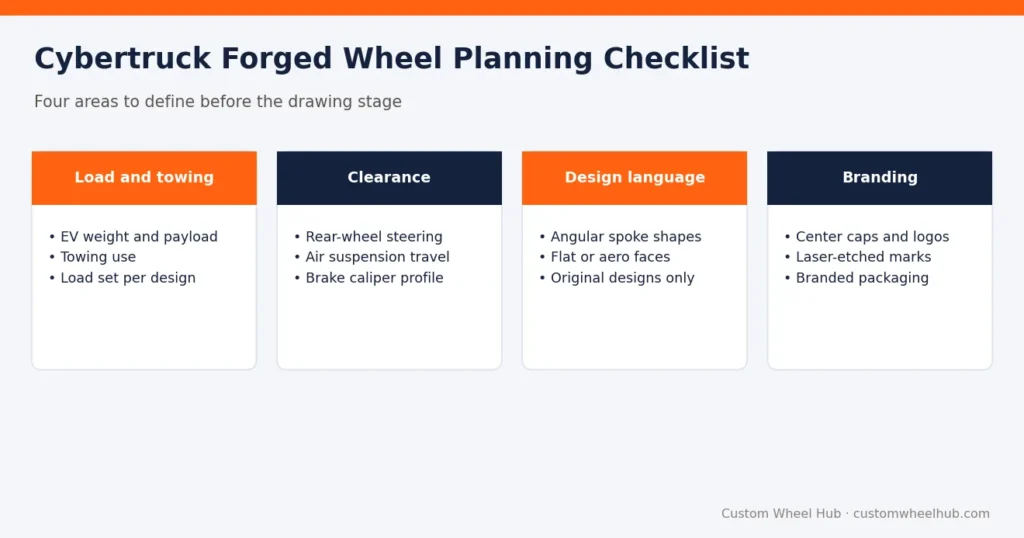
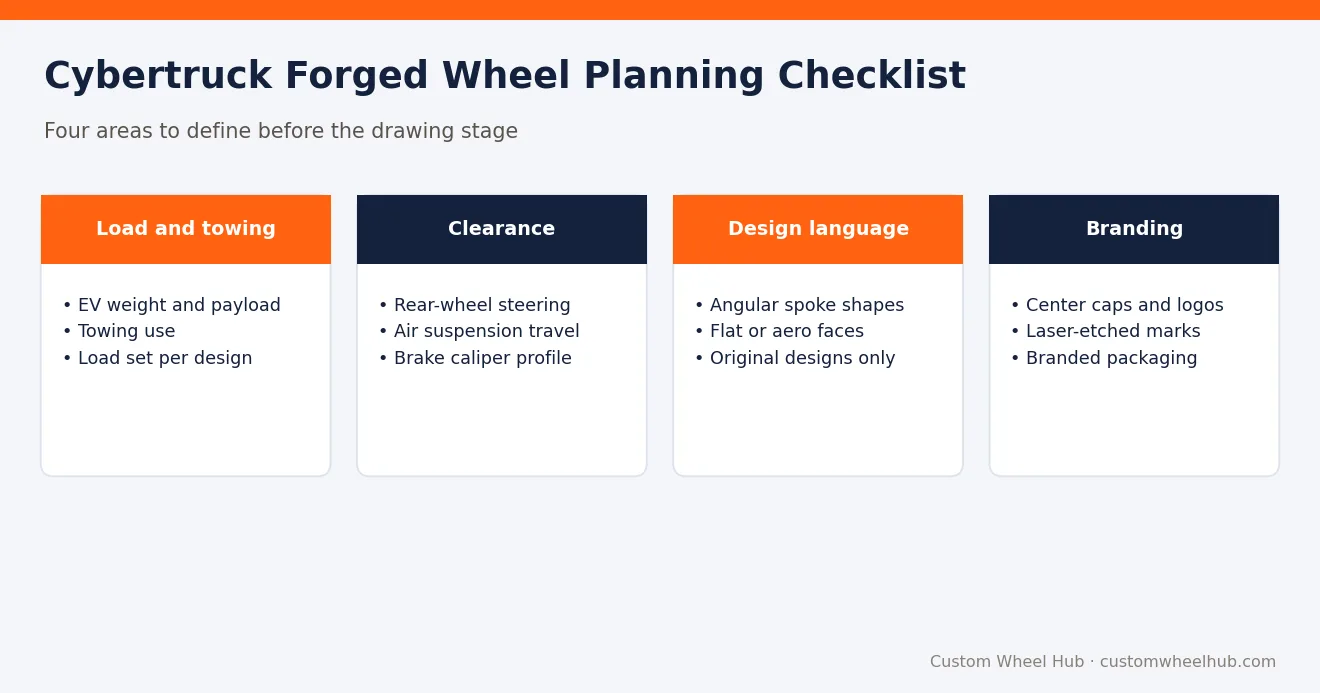
The Cybertruck combines several factors that are rarely found together in one vehicle: battery-electric weight, high torque, serious towing and payload use, adjustable air suspension and a steering system that can turn the rear wheels. Each of these affects wheel engineering.
- Weight and torque: spoke and hub areas carry high loads under acceleration and braking.
- Towing and payload: load requirements must reflect real use, not only curb weight.
- Rear steering: rear wheels need clearance through their steering range.
- Air suspension: wheel well clearance changes with ride height.
For brands already selling Tesla passenger car wheels, our Tesla Model Y and Model 3 sourcing guide is a useful reference, but the Cybertruck should be treated as its own program with its own data.
Load, Towing and Payload Planning
Load capacity is the first engineering question. Owners tow trailers, carry heavy cargo in the bed and fit roof or bed racks. We calculate the required load capacity for each design and size from the vehicle data, tire plans and intended use you provide. We do not quote generic load ratings, and we do not assume one figure suits every size or design.
If your market requires a wheel standard such as JWL, VIA or TÜV testing, tell us at the RFQ stage so testing can be planned. These are standards buyers may require for their market; our article on load ratings and JWL, VIA and TÜV standards explains what they cover and how buyers use them. Clear load requirements also help you write accurate product descriptions and avoid misuse claims later.
Tire choice is part of this discussion. Many owners move to larger all-terrain tires, which change overall diameter, weight and clearance. Share the tire sizes your customers ask for most, and we will check them against the planned rim width and offset on the drawing. A mismatch between tire and rim is easier to correct before the sample than after a container has shipped.
Fitment Parameters We Verify
We do not publish exact bolt patterns, offsets, center bores or tire sizes for the Cybertruck, because data can change with production updates and trims. Every wheel is engineered from your fitment sheet or OEM data, verified before drawing approval. We check:
- PCD and lug seat type, matched to the vehicle’s lug hardware.
- Center bore, for hub-centric fit on a heavy vehicle.
- Offset and width, against suspension, liners and the fender line.
- Brake caliper clearance on the spoke back side.
- Rear-wheel steering range and air suspension travel.
- TPMS sensor type and valve position.
Use our wheel PCD calculator to double-check bolt circle values from your data source before sending an RFQ.
Designing for the Cybertruck’s Angular Look
Round, flowing spoke designs that suit most trucks can look disconnected from the Cybertruck’s flat panels and sharp edges. Many brands design specifically for this vehicle, using straight-edged spokes, faceted surfaces, polygonal windows or flat aero-style faces that echo the body.
Some practical guidance from projects of this kind:
- Sketch the design against a side view of the truck, not on its own.
- Use flat or lightly concave faces; deep concavity can fight the body lines.
- Consider partial aero covers or inserts for road-focused SKUs.
- Keep edges crisp in the forging and machining plan, so the drawing matches the render.
Original design work is important here. Do not copy the vehicle maker’s own wheel or cover designs or use its logos; build your own design language that suits the truck.
Construction and Finish Options
The table below summarizes how buyers typically match construction and finish to Cybertruck use cases.
| Use case | Construction | Finish direction |
|---|---|---|
| Road and range focus | Forged monoblock | Satin or gloss, flat aero face |
| Off-road and overland | Forged monoblock | Textured or satin, durable coat |
| Premium styling | 2-piece forged | Brushed or two-tone accents |
| Show builds | 3-piece forged | Custom colors, polished lips |
Brushed and clear finishes are popular because they relate to the truck’s bare steel body. Satin black and gunmetal remain strong sellers for off-road SKUs.
Private-Label Branding for a Cybertruck Line
Many Cybertruck wheel lines are sold under a tuning brand rather than a wheel brand, so private-label work matters. We can apply your logo to center caps, laser-etch it on spokes or lips and supply branded boxes and inserts. Our private-label forged wheel branding guide covers logo methods and packaging choices in detail.
All logo positions, sizes and finishes appear on the drawing for approval and are confirmed on the sample. Keep branding consistent across sizes so the range looks like one product family. When you describe fitment in your marketing, use vehicle names descriptively and include a non-affiliation note.
MOQ, Samples and the Approval Path
MOQ is confirmed per project and depends on design, size, SKU count, finish and packaging. A launch with one road design and one off-road design in a small set of finishes is easier to quote and approve than a wide range.
The typical path is RFQ, fitment review, technical drawing, drawing approval, sample production and test fit, then mass production. On the Cybertruck, the test fit should cover full steering lock, rear steering and the lowest and highest ride heights with the planned tires. Production timing, shipping route and Incoterms are confirmed in the written quotation.
Because the vehicle is still relatively new to the aftermarket, keep a record of the fitment data source used for each order and re-confirm it before repeat production.
Vehicle names are used for fitment reference only; we are not affiliated with the manufacturers.
Request a Quote for Tesla Cybertruck Forged Wheels
If you are planning a forged wheel line for the Cybertruck, start with your fitment data, tire plans, load requirements and design direction. Browse our forged wheel products for construction references, then send your brief through the request a quote form, by email or on WhatsApp. We will review fitment and load needs and reply with a written quotation.
Frequently Asked Questions
Why does the Cybertruck need special load planning?
It combines battery-electric weight with towing and payload use, so wheel loads can be higher than a typical pickup of similar size. We calculate the required load for each design and size from the vehicle data, tire plans and use you provide, rather than using generic ratings.
Does rear-wheel steering affect wheel design?
Yes. Rear wheels that steer need clearance with suspension parts and liners through their full range, especially with larger tires or lower offsets. We check this during fitment review, and the sample test fit should include full steering movement at different ride heights.
Can you copy the factory Cybertruck wheel or aero cover design?
No. We work on original designs that suit the vehicle’s style, and we do not reproduce the vehicle maker’s wheel designs, covers or logos. We can help you develop an angular or aero-style design language that is your own and fits your brand.
Which finishes suit Cybertruck forged wheels?
Brushed clear finishes are popular because they relate to the stainless body. Satin black, gunmetal and textured coatings suit off-road SKUs, while two-tone and custom colors work for premium or show builds. Each finish is confirmed on a sample before production.
What should a Cybertruck wheel RFQ include?
Send your fitment sheet and data source, planned tire sizes, diameter and width, load and towing needs, construction, finish references, logo files, packaging needs and estimated quantities. We review the data, prepare a drawing and reply with a written quotation covering MOQ, timing, shipping route and Incoterms.
Get a quick forged wheel quote
Send your vehicle platform, wheel size, PCD, offset, finish and quantity. We confirm fitment and reply within 24 hours.