
Quick answer: Choose a monoblock forged wheel when low part count, direct fitment engineering and a clean performance-focused product are the priorities. Choose a 2-piece wheel when you need more width, offset and finish flexibility without the full complexity of a modular 3-piece assembly. Choose a 3-piece wheel when maximum lip, barrel and service configuration is central to the product concept. The construction name alone does not prove weight, strength or suitability; the approved drawing, load target, materials, fasteners, sealing method and test evidence still decide the result.
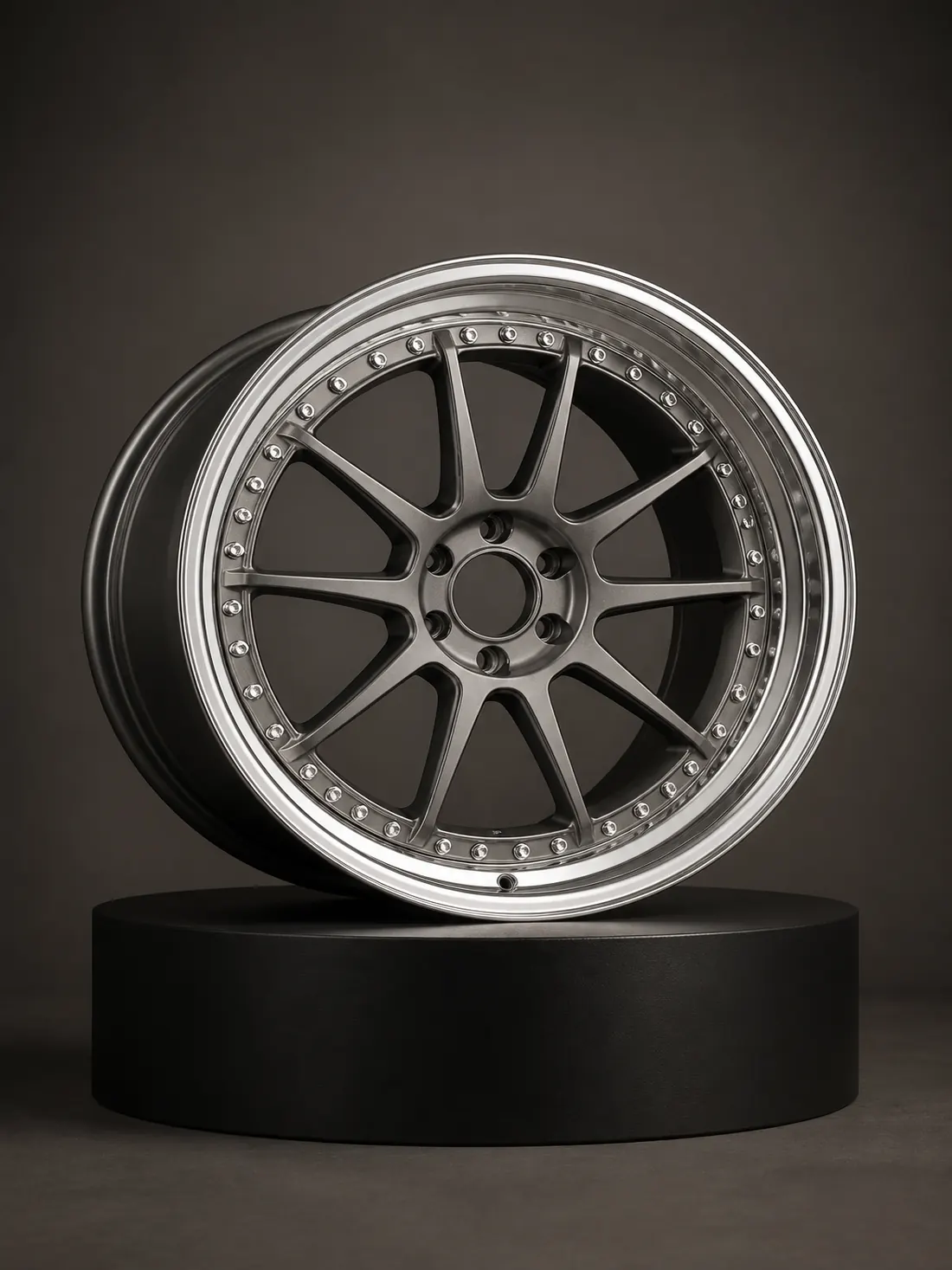
For procurement, start with the vehicle and commercial use case—not the number of pieces. A technically correct monoblock can be a better premium product than an over-complicated modular design, while a 3-piece construction can be the right answer for a low-volume show or specialty fitment program.
2-Piece vs 3-Piece vs Monoblock at a Glance
| Construction | Typical architecture | Main advantage | Main trade-off | Best-fit program |
|---|---|---|---|---|
| Monoblock | One wheel body machined from a forged blank | Low part count, straightforward sealing and a direct engineering path | Width, lip and barrel changes usually require a new wheel specification | Performance, luxury, EV and repeatable vehicle-specific fitments |
| 2-piece | Forged center joined to a separate barrel | Useful balance of offset, width, finish and component flexibility | Assembly hardware and joint design add specification and QC steps | Premium private-label ranges and mixed-fitment dealer programs |
| 3-piece | Center plus separate inner and outer rim sections | Maximum modularity for lip depth, width, repair and visual configuration | More components, sealing interfaces, hardware and service requirements | Show, bespoke, specialty-width and highly configurable programs |
What Is a Monoblock Forged Wheel?
A monoblock wheel is produced as one structural wheel body. The center, spokes, mounting pad and rim are engineered together, so there are no assembly bolts or rim-section sealing joints. This makes the architecture attractive when buyers want a focused combination of fitment, stiffness targets, low part count and a clean visual design.
Monoblock does not automatically mean the lightest wheel. Final mass depends on diameter, width, offset, load target, spoke section, brake clearance, rim profile and the safety margin used in the approved design. Ask the supplier for the proposed drawing and target weight for the exact fitment rather than comparing generic catalog claims.
When a 2-Piece Forged Wheel Makes More Sense
A 2-piece design normally separates the center from the barrel. That separation can make it easier to plan multiple offsets, widths, center finishes or replacement components around a common product direction. It is often a practical architecture for a brand that wants more visual and fitment variety than a monoblock program but does not need the full modularity of three pieces.
- Private-label collections: one spoke family can be coordinated with several barrel and finish combinations.
- Deep-lip or stepped-lip styling: the center and barrel relationship can be designed around the intended look.
- Mixed front and rear fitments: staggered widths and offsets can be planned as separate approved specifications.
- Finish separation: the center and barrel can use different approved finish directions, subject to process compatibility.
Why Buyers Choose 3-Piece Forged Wheels
A 3-piece wheel uses a center, an inner rim section and an outer rim section. The architecture is valuable when lip depth, exact width, component replacement or a highly bespoke appearance is part of the product proposition. It also creates more details to control: fastener specification, tightening procedure, sealing, runout, component compatibility and after-sales service instructions.
For a dealer or wheel brand, confirm who is authorized to disassemble or reseal the wheel and what service documentation will accompany it. A modular design only adds commercial value when the after-sales process is as clear as the initial design.
Six Questions That Decide the Right Construction
- What vehicle and brake package must the wheel clear? Provide year, model, trim, axle position and brake details.
- Is the priority low mass, lip depth, concavity, serviceability or range flexibility? Rank these instead of asking for all of them at once.
- How many fitments and finishes will the launch include? Every split creates another SKU and approval path.
- What load and validation evidence is required? Confirm the target market and exact test/document scope before design freeze.
- How will the wheel be serviced? Modular assemblies require clear hardware, torque, sealing and inspection instructions.
- What is the repeat-order plan? A construction that works for one show vehicle may be inefficient for a repeatable wholesale range.
RFQ Data to Send for a Construction Recommendation
| Input | Minimum information | Why it matters |
|---|---|---|
| Vehicle | Make, model, year, trim, brake package and axle position | Defines the physical fitment envelope |
| Wheel | Diameter, width, PCD, center bore and target offset | Establishes the mounting and rim specification |
| Design | Spoke reference, lip or concavity goal and finish | Shows whether modular construction adds real value |
| Commercial scope | Quantity per SKU, branding, packaging and destination | Connects the architecture to cost and range complexity |
| Documentation | Required load marking, test standard or market approval | Prevents a visual design from being approved before compliance scope |
Review the available custom forged wheel constructions, then compare your preferred direction with the existing forged vs cast wheel guide. Real project types are shown in the forged wheel projects hub.
Frequently Asked Questions
Is a 3-piece forged wheel always stronger than a monoblock?
No. Piece count is not a strength grade. Strength and durability depend on the complete engineered specification, material condition, geometry, joining system, manufacturing control and applicable validation.
Can a 2-piece wheel use different finishes on the center and barrel?
Often yes, but the exact combination must be approved for the materials, preparation, masking and assembly sequence used on that project.
Which construction is best for a new private-label brand?
A focused monoblock or 2-piece range is often easier to control, but the right choice depends on target vehicles, design promise, quantities, service model and price position.
Choose the Construction From Your Fitment
Send the target vehicle, wheel size, PCD, center bore, offset, brake package, preferred design, finish, quantity and destination. The next step is a construction recommendation and project-specific quotation—not a generic piece-count answer.