Quick answer
Jeep Wrangler custom forged off-road wheels are planned around lift height, tire size, backspacing, hub-centric fit, lug seat type and load from heavy tires and accessories. Decide whether you need true beadlock or simulated beadlock designs, and whether a matching spare is part of the set. Every specification is verified from the buyer’s fitment data before drawing approval.
The Wrangler is one of the most modified vehicles in the off-road world. Owners fit lift kits, large all-terrain or mud tires, heavy bumpers and winches, then drive on rocks, sand and trails. Wheels for this market must be strong, offer the right backspacing for larger tires, and still look good in town.
This guide is for off-road shops, distributors and wheel brands planning a Wrangler program. It covers fitment checks, setup planning, beadlock choices, construction and finishes, and how to prepare a request for quotation that leads to accurate drawings.
How Wrangler Buyers Use Their Wheels
Wrangler customers range from weekend trail drivers to serious rock crawlers and overlanders. Each group puts different demands on the wheel. Trail drivers want durable finishes and a clean look. Rock crawlers want strength, rim protection and often beadlocks for low tire pressure. Overlanders care about load, because their vehicles carry roof tents, water and recovery gear for long distances.
- Daily and trail: durable finish, moderate tire size
- Rock crawling: strength, beadlock options, rim protection
- Overlanding: load considerations, repairability, spare wheel matching
Defining these segments before you brief the factory helps you choose widths, backspacing and construction that suit real customers. It also keeps your catalog focused, so you stock the configurations people actually buy rather than every possible combination.
Fitment Parameters to Verify
We do not publish exact bolt patterns, offsets or center bores for specific Wrangler model years. Generations, axles and aftermarket parts vary, so the buyer’s fitment sheet or OEM data is verified before drawing approval.
| Parameter | Wrangler consideration | Verification |
|---|---|---|
| PCD | Must match axle hubs for each generation | PCD calculator and fitment sheet |
| Offset and backspacing | Controls tire position, scrub and fender clearance | Offset calculator |
| Center bore | Hub-centric fit supports stability with heavy tires | Center bore calculator |
| Brake clearance | Aftermarket brake upgrades need checking | Caliper template or measurements |
| Lug seat | Must match OEM or aftermarket lug nuts | Hardware specification |
Lift Height, Tire Size and Backspacing
On a Wrangler, the wheel and tire are chosen together with the lift. Larger tires need more space, and backspacing decides where that space comes from. Less backspacing pushes the tire outward, which improves clearance to suspension parts and gives a wider stance, but it also changes steering feel and load on wheel bearings.
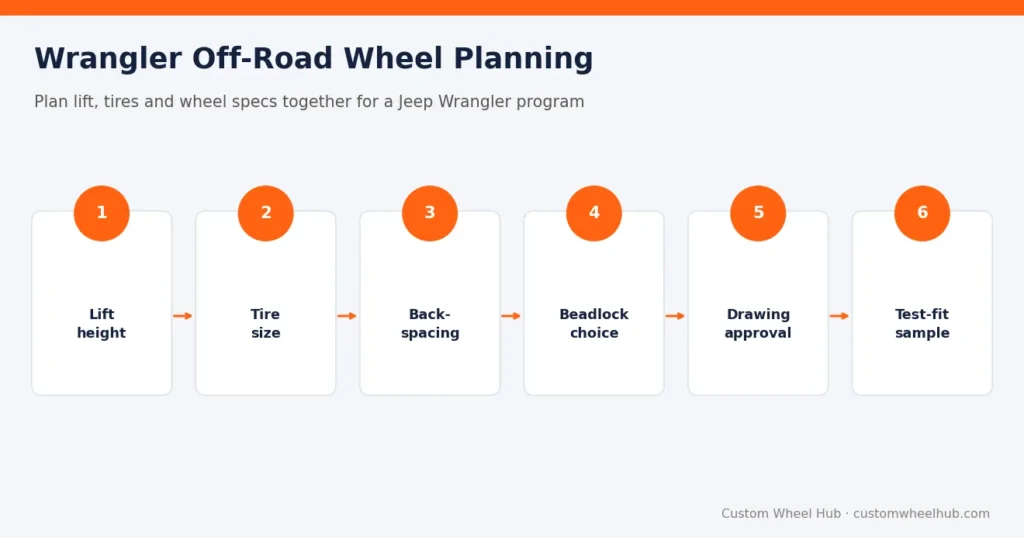
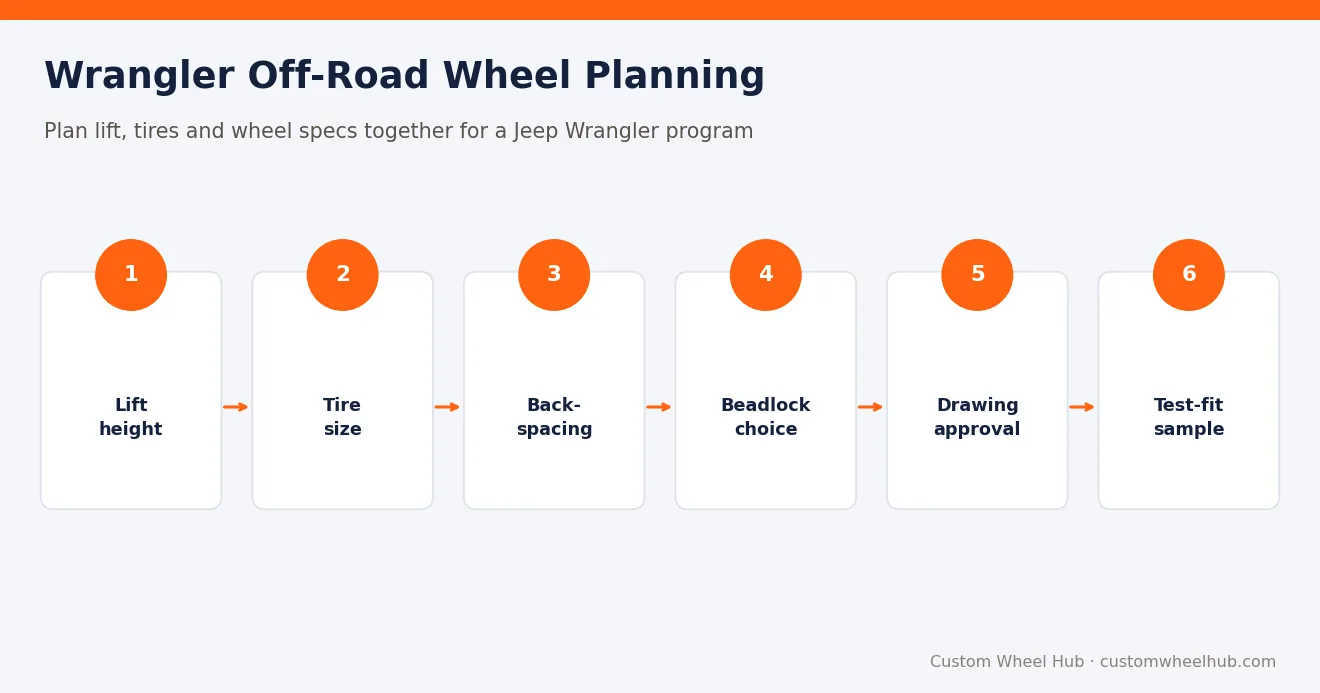
- Define lift heights you will support
- Choose target tire sizes for each lift
- Agree on desired stance and fender position
- Let engineering propose width and backspacing
- Confirm on a test vehicle before approval
Ask your sales team which lift and tire combinations your customers request most. Building the program around those combinations keeps the SKU list manageable and makes it easier to give customers clear fitment guidance at the point of sale.
True Beadlock or Simulated Beadlock
Rock crawlers often air down to very low pressures for grip, which can cause the tire bead to slip off the wheel. A true beadlock clamps the tire bead mechanically with a ring and bolts. A simulated beadlock offers the same rugged look without the clamping function and is easier to maintain for street use.
True beadlocks require more hardware, regular bolt checks and, in some markets, may face road-use restrictions. Simulated beadlocks suit customers who want the look but drive mainly on roads and light trails. Our guide to beadlock vs simulated beadlock wheels explains the trade-offs in detail. Whichever you choose, state it in the brief so the drawing reflects the ring design, hardware and finish.
Load Considerations for Heavy Builds
Modified Wranglers are often much heavier than stock. Steel bumpers, winches, armor, larger tires and camping gear all add weight, and off-road impacts add shock loads. Wheel engineering should account for the realistic weight of your customers’ vehicles, not just factory curb weight.
Share the typical build weight and use case in your brief. Our engineers review load considerations during the drawing stage, including spoke design, rim thickness and the mounting pad. If your market requires wheels to meet a specific standard, such as JWL or VIA, state that requirement so testing responsibilities can be discussed and confirmed in writing. We explain these standards to buyers; we do not claim to hold them.
Spare Wheel Matching and Set Planning
Many Wrangler owners mount a full-size spare on the tailgate and want it to match the other four wheels. Some also rotate the spare into use on long trips. This changes how you package and sell a set: a five-wheel set may be more attractive to this market than a standard set of four.
Consider the tailgate carrier and any third brake light or camera position when the spare is a larger diameter. If your customers fit heavier spares, they may also need an upgraded carrier. Discuss five-wheel packaging, labeling and pricing structure with your sales team so the set offer is clear. Engineering can confirm that the spare matches the main wheels in fitment and finish.
Construction, Finishes and Branding
Forged monoblock wheels are a strong choice for off-road programs because they combine strength and lower weight, which helps unsprung mass with heavy tires. Cast alloy wheels can serve entry-level or volume programs focused mainly on road use.
Off-road finishes need to resist stone chips, mud and cleaning. Matte black, satin bronze, gunmetal and textured coatings are common. Machined accents look sharp but show trail damage sooner. For branding, consider engraved logos on the ring, custom center caps and rugged packaging.
- Choose finishes that resist chips and abrasion
- Approve color and texture on samples
- Confirm logo position on rings or spokes
Off-road buyers also value consistency across product lines. If you sell wheels for other trucks and SUVs, consider a shared design language so customers recognize your brand across platforms.
Request a Quote for Jeep Wrangler Forged Wheels
Send the generations you support, lift and tire combinations, fitment data, beadlock choice, typical build weight, finishes, branding, set size and estimated quantities. MOQ is confirmed per project by design, size, SKU, finish and packaging, and production timing, shipping route and Incoterms are confirmed in the written quotation. Distributors can also review our dealer and wholesale program.
Submit your brief through the request a quote form, or contact us by email or WhatsApp. We review your data and reply with drawings, sample plans and a written quotation.
Note: Vehicle names are used for fitment reference only; we are not affiliated with the manufacturers.
Frequently Asked Questions
What backspacing should a lifted Wrangler use?
The right backspacing depends on lift height, tire size, suspension parts and the stance your customers want. We do not publish generic values. Share your target lift and tire combinations with fitment data, and our engineers propose width and backspacing for each. You confirm the result on a test vehicle before approving drawings.
Should an off-road program include true beadlocks?
True beadlocks suit serious rock crawlers who run very low tire pressures, but they need more hardware and maintenance and may face road-use rules in some markets. Simulated beadlocks give the look with easier upkeep. Many programs offer both, aimed at different customer segments, and state the intended use clearly.
Can you supply a matching fifth wheel for the spare?
Yes. A matching spare can be included in the set and produced in the same finish and fitment as the main wheels. If the spare is larger than stock, check the tailgate carrier and any camera or light positions. Packaging and labeling for five-wheel sets are confirmed before production.
How do you account for heavy bumpers, winches and gear?
Share the typical build weight and use case in your brief. Our engineers review load considerations during the drawing stage, including spoke design and rim thickness. If your market requires a specific wheel standard, state it so testing responsibilities can be discussed and confirmed in writing with the quotation.
Which finishes hold up best on trail wheels?
Matte and satin coatings in black, bronze or gunmetal, as well as textured finishes, tend to hide trail wear well. Machined faces look sharp but show damage sooner. Any finish you choose is applied to samples first, so you can check color, texture and durability before production begins.
Get a quick forged wheel quote
Send your vehicle platform, wheel size, PCD, offset, finish and quantity. We confirm fitment and reply within 24 hours.