Quick answer
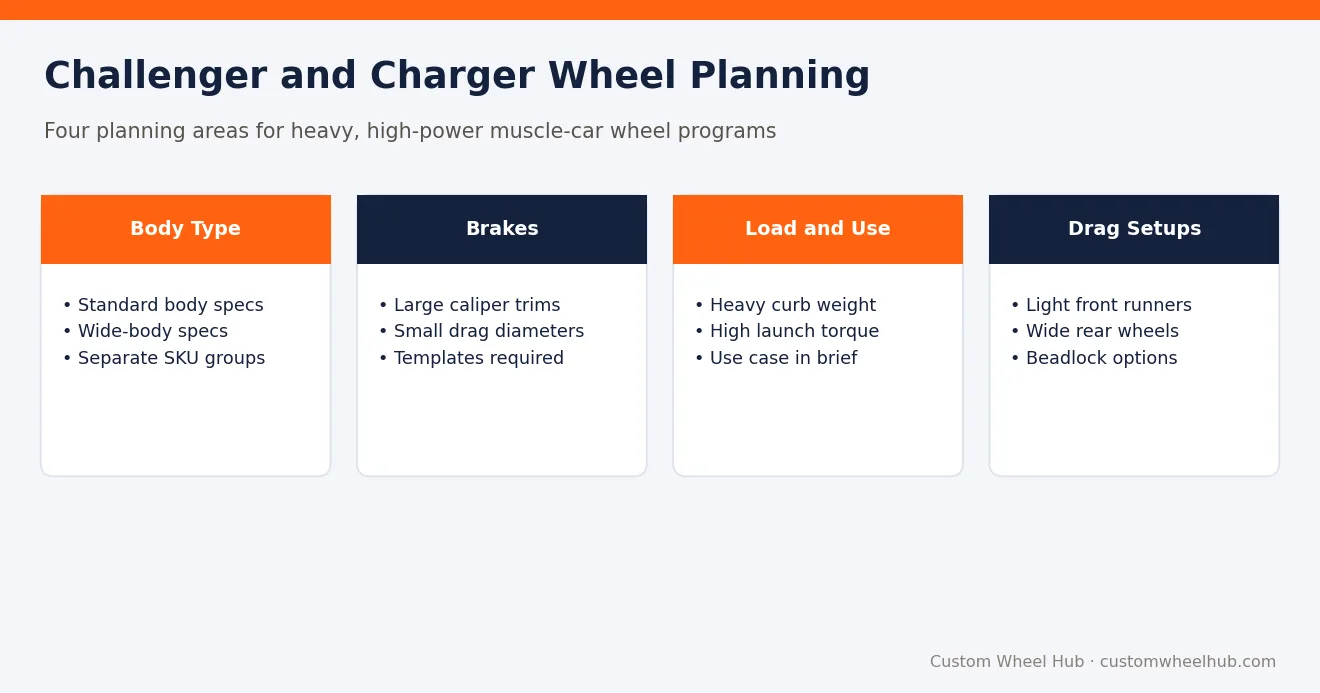
Dodge Challenger and Charger custom forged wheels must handle heavy cars with high power, so engineering focuses on load considerations, brake caliper clearance, hub-centric fit and lug seat type. Wide-body and standard-body cars need separate fitment specs. Programs often include street, wide-body and drag setups, with every SKU confirmed through drawing approval and test-fit samples.
The Challenger and Charger built a large following among muscle-car owners who add power, wide-body kits and drag-racing parts. These cars are heavy and fast, which places real demands on wheels. A program for this platform needs to balance aggressive styling with strength, brake clearance and correct fitment.
This guide is written for wheel brands, distributors and tuning shops. It explains how to separate wide-body and standard fitments, which checks matter for high-power builds, and how to prepare a clear request for quotation.
Why These Muscle Cars Need Careful Wheel Engineering
The Challenger and Charger combine significant vehicle weight with high torque, especially in supercharged versions. Hard launches, heavy braking and high-speed driving all put stress on the wheel. Many owners add power after purchase, so a wheel program should be planned for the strongest builds you expect to support.
For engineering, this means paying attention to spoke cross-section, hub mounting area and rim design. Load considerations for this platform are reviewed during the drawing stage, and buyers who need wheels to meet a regional standard should state it in the brief. Standards such as JWL, VIA and TÜV are explained as requirements that buyers may need for their markets; they are discussed case by case.
- Heavy curb weight and high torque
- Frequent power upgrades after purchase
- Drag strip and high-speed use
Standard Body vs Wide-Body Fitment
Wide-body versions of these cars have different fender widths from standard-body versions, which changes the ideal wheel width and offset. Some owners also install aftermarket wide-body kits. Each of these is a separate fitment target and should be treated as its own SKU group.
When briefing the factory, specify which body types you will support, the tire sizes you plan to sell, and the visual position you want for the wheel face relative to the fender. Engineering then proposes widths and offsets for each body type, and test-fit samples confirm the result. Do not assume that a standard-body wheel will look right on a wide-body car, or the reverse.
Aftermarket wide-body kits add another layer. Different kit makers use different flare widths, so the right offset depends on the exact kit installed. If you sell to shops that fit a particular kit, include its measurements or a reference vehicle in the brief. Engineering can then propose sizes that fill the flares correctly while keeping safe clearance to suspension parts and the inner fender liner.
Fitment Parameters to Verify
We do not publish exact bolt patterns, offsets or center bores for specific model years. The buyer’s fitment sheet or OEM data is verified before drawing approval.
| Parameter | Challenger and Charger consideration | Verification |
|---|---|---|
| PCD | Confirm for each supported model and year range | PCD calculator and fitment sheet |
| Offset | Differs between standard and wide-body cars | Offset calculator |
| Center bore | Hub-centric fit supports smooth high-speed driving | Center bore calculator |
| Brake clearance | High-performance trims use large calipers | Caliper template or scan |
| Lug seat | Must match chosen hardware | Hardware specification |
Brake Clearance on High-Performance Trims
High-performance trims of these cars use large multi-piston front calipers. Brake clearance needs to be checked for every diameter you plan to offer, and it becomes especially important for smaller drag-racing diameters. A spoke design that clears on a large street wheel may contact the caliper on a smaller wheel.
- List all brake setups you plan to support
- Provide caliper templates or measurements
- Review spoke and barrel clearance in the drawing
- Confirm on test-fit samples before production
Some drag racers convert to smaller brakes to fit smaller front wheels. If your program targets that market, state the brake setup in your brief so engineering can design for it.
Drag Racing Setups
Drag racing is a major segment for these cars. A typical drag setup uses lightweight, narrow front wheels and wide rear wheels built for drag radials or slicks. The rear wheel has to transfer high launch torque, while the front wheel should be as light as practical.
Some customers also ask about beadlock or simulated beadlock designs to prevent tire slip on launch. These choices affect design, hardware and how the wheel is used, so discuss them early. Our article on beadlock vs simulated beadlock wheels explains the differences. Every drag configuration is confirmed with fitment data and test-fit samples before production.
Construction, Finishes and Branding
Forged monoblock wheels are the default choice for high-power builds because they offer strength and stiffness with no assembly hardware. Two-piece and three-piece wheels suit show cars and wide-body builds where deep lips and two-tone finishes are part of the look.
Popular finishes include gloss black, satin black, bronze, chrome-look and machined faces. For brand identity, specify center caps, logo engraving and branded packaging. All finish and branding details are confirmed on samples.
- Monoblock: high-power street and drag use
- 2-piece: wide-body builds with deeper lips
- 3-piece: show builds with custom finishes
MOQ, Sampling and Production Planning
MOQ is confirmed per project based on design, size, SKU count, finish and packaging. Because this platform includes standard and wide-body fitments as well as drag setups, SKU counts can grow quickly. Start with the configurations your customers request most, then expand.
All projects go through drawing approval and samples before mass production. Production timing, shipping route and Incoterms are confirmed in the written quotation. Heavy wheels with large diameters also need strong packaging, so agree on packaging specifications before production begins.
Plan for finish consistency across reorders too. Muscle-car buyers often purchase one set and later return for a second set for a winter car or a drag setup, and they expect the color to match. Keeping approved samples on file and confirming finish codes in each order helps every batch match the original. Clear labeling by body type and axle also reduces picking errors in your warehouse.
Request a Quote for Dodge Challenger and Charger Forged Wheels
Send the models, body types and year ranges you want to support, target sizes, fitment data, brake setups, construction, finish, branding and estimated quantities. You can also browse our forged wheel products for design references.
Submit your brief through the request a quote form, or contact us by email or WhatsApp. We review your data and reply with drawings and a written quotation.
Note: Vehicle names are used for fitment reference only; we are not affiliated with the manufacturers.
Frequently Asked Questions
Do wide-body Challengers need different wheels from standard-body cars?
Yes. Wide-body cars have different fender widths, so the ideal wheel width and offset differ from standard-body cars. We treat each body type as a separate fitment target with its own drawing and test-fit sample. This avoids wheels that sit too far inboard on a wide-body car or rub on a standard one.
Can you build drag wheels for supercharged Challenger and Charger models?
Yes. We engineer drag setups with lightweight front wheels and wide rear wheels based on your fitment data and brake setup. Launch loads and brake clearance on smaller diameters are reviewed during the drawing stage, and test-fit samples are approved before any mass production begins.
How are load requirements handled for heavy, high-power cars?
Our engineers review load considerations for the platform during the drawing stage, including vehicle weight and intended use. If your market requires a specific standard such as JWL, VIA or TÜV, state it in your brief so testing responsibilities can be discussed and confirmed in writing with the quotation.
Do you publish bolt patterns and offsets for these cars?
No. We do not publish fixed fitment values for specific model years, because options and running changes vary. Your fitment sheet or OEM data is verified and built into the drawing. Our online calculators can help you cross-check, but the approved drawing is always the final reference.
What finishes are popular for Challenger and Charger wheels?
Gloss black, satin black, bronze, chrome-look and machined faces are common. Two-tone finishes with polished lips suit multi-piece wheels on show and wide-body cars. Any finish you choose is produced on samples first, so you can approve color, gloss level and branding before production starts.
Get a quick forged wheel quote
Send your vehicle platform, wheel size, PCD, offset, finish and quantity. We confirm fitment and reply within 24 hours.