Quick answer
Ford Mustang custom forged wheels should be planned by generation and trim, because brake packages, hub details and body widths vary. Verify fitment from the buyer’s data, check caliper clearance for performance packages, and decide whether you sell street, staggered, track or drag setups. Forged monoblock suits most programs, while cast alloy can support high-volume entry lines.
The Mustang is one of the largest aftermarket wheel markets in the world. Owners range from daily drivers who want a cleaner look to drag racers and road-course enthusiasts who need specific widths and strong, light wheels. For distributors and tuning shops, that variety is an opportunity, but only if the wheel program is organized carefully.
This guide explains how to segment a Mustang program by generation and use case, which fitment checks matter, how to choose construction and finishes, and what to send in a request for quotation.
Segment the Program by Generation and Use
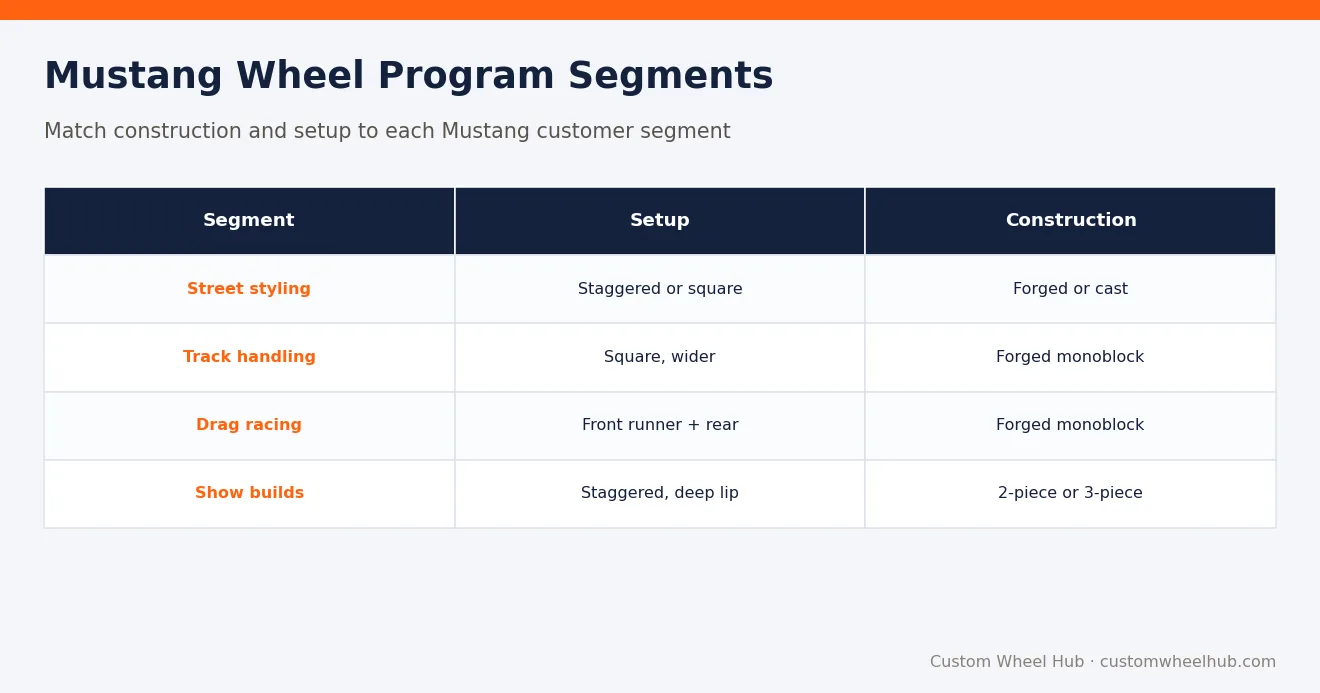
Mustang buyers do not all want the same wheel. A distributor that tries to cover every generation and driving style with a single size usually ends up with slow-moving stock. A better approach is to define clear segments first and then assign designs and sizes to each.
- Street styling: larger diameters, clean faces, popular finishes
- Track and handling: lighter wheels, wider square or staggered setups
- Drag racing: narrow front runners and wide rear wheels for drag tires
- Show builds: multi-piece wheels with custom lips and two-tone finishes
Within each segment, confirm which generations and trims you will support. Body width, brake package and suspension geometry differ across the range, so each supported variant needs its own verified fitment data before the factory issues drawings.
Fitment Parameters to Verify for Each Generation
We do not publish bolt patterns, offsets or center bores for specific Mustang model years. Running changes and option packages make fixed numbers risky. Your fitment sheet or OEM data is verified before drawing approval.
| Parameter | Mustang consideration | Verification |
|---|---|---|
| PCD | Confirm for each supported generation | PCD calculator and fitment sheet |
| Offset | Varies with body width and brake package | Offset calculator per axle |
| Center bore | Hub-centric fit improves ride and balance | Center bore calculator |
| Brake clearance | Performance packages use larger calipers | Caliper template or measurements |
| Lug seat | Match OEM or chosen aftermarket hardware | Hardware specification |
Brake Packages and Caliper Clearance
Performance-oriented Mustang trims use larger front brakes, and many owners fit aftermarket brake kits. A wheel that clears a base model may not clear a performance package. When briefing a factory, list every brake setup you plan to support and supply caliper templates or measurements for the largest one.
Engineers then check the back of each spoke, the barrel inner diameter and any undercut near the caliper. If your segment includes smaller diameters for drag racing, brake clearance becomes even more critical, because smaller wheels leave less room around the caliper. Confirm clearance on test-fit samples before approving production.
It also helps to record which brake setup each SKU is approved for. When a distributor sells to many shops, clear compatibility notes in the catalog and on the box reduce wrong orders and returns. Ask the factory to include the approved brake reference on the drawing, so your sales team and your customers can check compatibility quickly. This small step saves time later when new brake kits enter the market and customers ask whether an existing wheel will clear them.
Staggered, Square and Drag Setups
Mustang wheel programs often include three setup types. Staggered setups keep the classic muscle-car stance with wider rears. Square setups are popular for track use because they allow tire rotation and balanced handling. Drag setups pair a narrow, lightweight front wheel with a wide rear wheel designed for drag radials or slicks.
- Choose which setups each design will support
- Define target tire sizes for every setup
- Have engineering propose width and offset per axle
- Approve drawings and test-fit samples
Drag wheels deserve particular attention. They must clear brakes on a smaller diameter, carry high launch loads and often need a strong bead-seat design. Discuss these requirements with engineering at the start, rather than adapting a street design later.
Forged, Flow-Formed or Cast: Building a Product Ladder
Because the Mustang market is large, many distributors build a product ladder. Forged monoblock wheels sit at the top for performance and premium styling. Multi-piece forged wheels serve show builds. Cast alloy wheels can support high-volume entry programs where price sensitivity is higher and the use is mainly street driving.
A ladder lets one brand serve several customer types without confusing them. Keep design language consistent across levels so customers recognize your brand, while being clear about construction differences. For a detailed comparison of the processes, read forged vs flow-formed vs cast wheels.
Finishes and Branding for Mustang Buyers
Mustang owners often match wheels to factory paint colors and stripe packages. Gloss black, satin black, bronze, gunmetal and polished or machined faces are frequent requests. Two-tone finishes work well on multi-piece wheels with polished lips.
Branding builds repeat business. Specify center caps, logo engraving on the spoke or lip, and branded packaging. If you sell into multiple countries, consider printing packaging and labels to suit each market. All finishes and branding details are confirmed on physical samples before production.
- Approve color and gloss level on samples
- Confirm logo placement in the drawing
- Lock packaging artwork before mass production
MOQ, Samples and Inventory Planning
MOQ is confirmed per project based on design, size, SKU count, finish and packaging. Because Mustang programs can easily grow to many SKUs, start with the highest-demand sizes and finishes for each segment, then add variants as sales data comes in.
Drawing approval and samples come before production for every SKU. Production timing, shipping route and Incoterms are confirmed in the written quotation, so inventory planning is based on agreed terms. Distributors with multiple warehouses should state destination ports early so the quotation reflects the right shipping plan.
Consider how you will handle reorders as well. Popular sizes in core finishes sell steadily, while special colors and show-build sizes move more slowly. Agreeing on how reorders are scheduled and how finish consistency is maintained between batches helps you keep shelves stocked without carrying too much slow inventory. Keep approved samples on file so later batches can be compared against the original standard.
Request a Quote for Ford Mustang Forged Wheels
Send the generations and trims you want to support, target sizes per setup, fitment data, brake packages to clear, preferred construction, finishes, branding and estimated quantities. Distributors can also review our dealer and wholesale program.
Submit your brief through the request a quote form, or contact us by email or WhatsApp. Our engineering team reviews the data and replies with drawings and a written quotation.
Note: Vehicle names are used for fitment reference only; we are not affiliated with the manufacturers.
Frequently Asked Questions
Can one wheel design cover several Mustang generations?
Sometimes the same face design can be offered across generations, but each supported variant is engineered with its own width, offset and clearance checks based on verified fitment data. We recommend confirming which generations you will sell before drawings are issued, so each SKU is approved separately and fits correctly.
Do you make drag wheels for the Mustang?
Yes. We can engineer narrow front runners and wide rear wheels designed around drag tires, based on your fitment data and brake setup. Drag wheels need careful attention to brake clearance on smaller diameters and to launch loads, so we review these requirements with you during the drawing stage.
Should a distributor offer cast wheels alongside forged wheels?
Many distributors do. Cast alloy wheels can serve high-volume street programs, while forged wheels serve performance and premium buyers. Keeping a consistent design language across both levels helps customers recognize the brand. We can discuss which designs suit each construction type when you send your program brief.
How do you avoid brake clearance problems on performance trims?
We ask for caliper templates or measurements of the largest brake setup you plan to support. Our engineers check spoke backs, barrel inner diameter and undercut areas in the drawing. Samples are then test-fit on a vehicle, and you approve them before any mass production begins.
What determines the MOQ for a Mustang program?
MOQ is confirmed per project based on design, size, number of SKUs, finish and packaging. Programs with many sizes and finishes usually need more planning than a focused launch. The written quotation confirms MOQ, production timing, shipping route and Incoterms so you can plan inventory with confidence.
Get a quick forged wheel quote
Send your vehicle platform, wheel size, PCD, offset, finish and quantity. We confirm fitment and reply within 24 hours.