Quick answer
Custom forged wheels for Bentley and Rolls-Royce models must suit very heavy luxury vehicles where ride comfort, quietness and finish quality matter as much as style. Buyers send verified fitment data for each model, tire plans and finish references. The factory checks load needs, hub-centric fit, brake clearance and TPMS, approves a drawing and sample, then quotes MOQ and Incoterms in writing.
Bentley and Rolls-Royce owners rarely change wheels for performance. They do it for presence, personalization and a finish that matches the rest of a highly specified car. At the same time, these are some of the heaviest passenger vehicles on the road, and their owners expect the ride to stay smooth and quiet after the wheels are changed.
This guide is for luxury dealers, coachbuilders, customization studios and wheel brands planning forged wheels for Bentley and Rolls-Royce models. It covers how to group the model ranges, which fitment and load questions to answer, how to approach design and finishes, and how the RFQ, drawing and sample process works.
Grouping Models for a Luxury Wheel Program
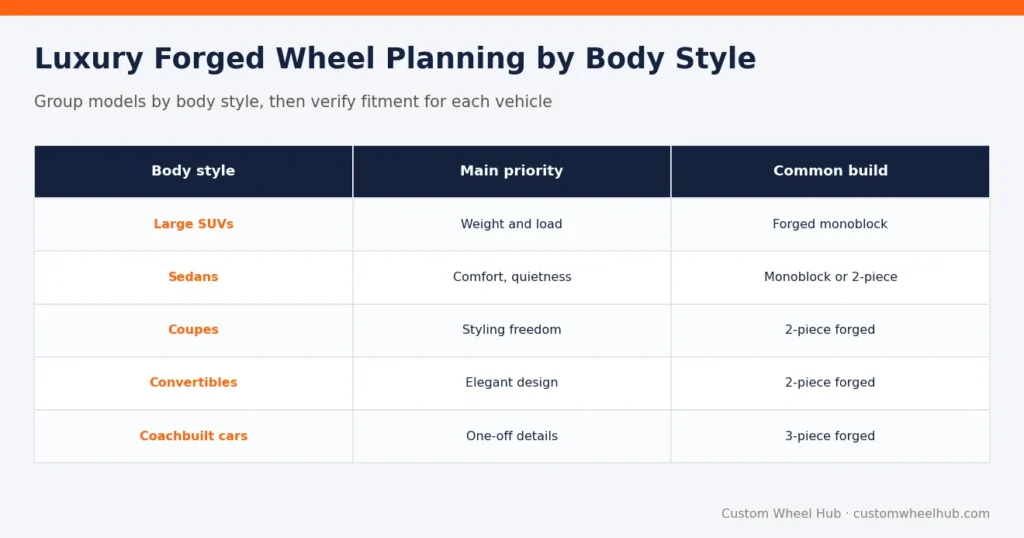
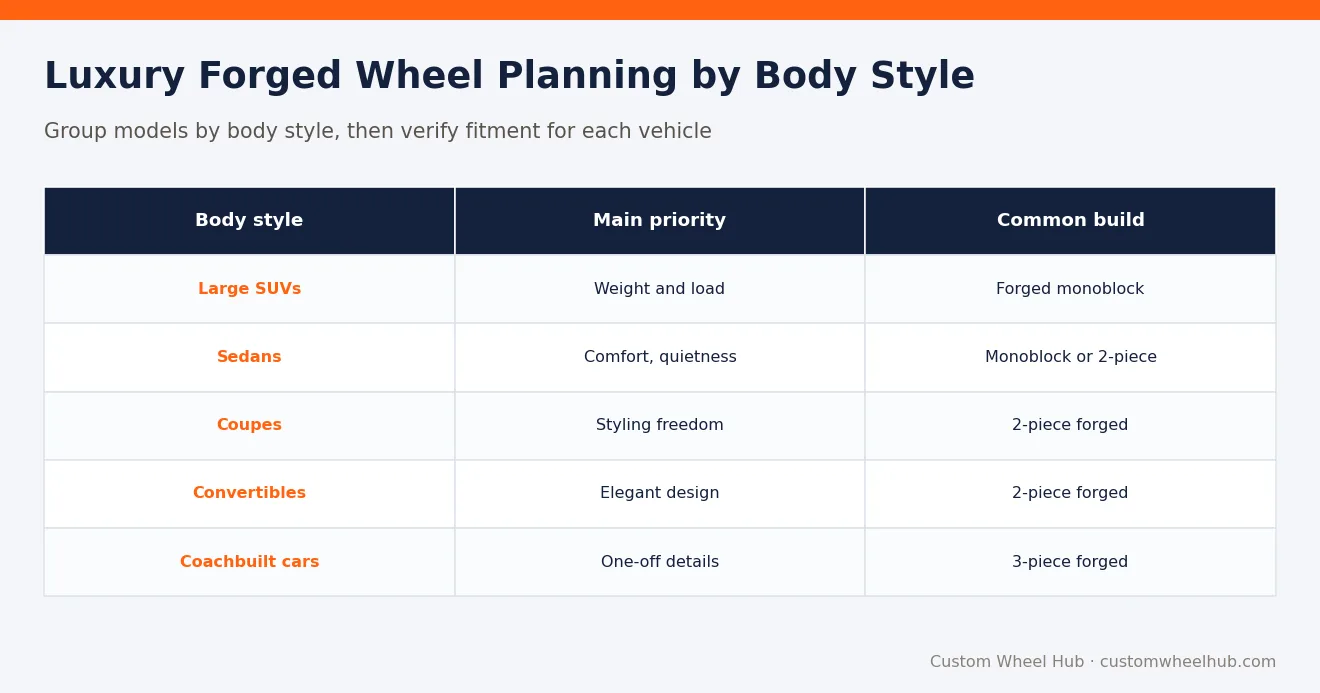
Both brands offer sedans, coupes and convertibles alongside large SUVs, and wheel requirements differ between these body styles. Weight, brake size, wheel well space and the diameters owners expect all vary.
- Large SUVs: highest weight, largest diameters and heavy daily use.
- Sedans and limousines: comfort and quietness are top priorities.
- Coupes and convertibles: more styling freedom and sportier sizes.
- Electric models: extra weight and separate fitment review.
Plan designs by group, then confirm fitment for each model, generation and market. A design language can be shared across both brands, but the engineering behind each wheel should be checked against the correct vehicle data. If you also supply luxury SUV programs, our Range Rover forged wheels guide covers similar weight and comfort questions.
Fitment Data We Verify
We do not publish exact bolt patterns, offsets, center bores or tire sizes for Bentley or Rolls-Royce models, because these vary by model, year and market. Every project is engineered from your fitment sheet or OEM data, which we verify before drawing approval.
- PCD and lug seat type, matched to the car’s lug bolts.
- Center bore, with hub-centric fit to support a heavy vehicle.
- Offset and width, checked against suspension, liners and fenders.
- Brake clearance, including larger optional brake packages.
- TPMS sensor type and valve position.
- Any special center cap requirements in your design.
Our center bore calculator helps compare hub sizes when one design will be offered for several models.
Weight, Load and Ride Comfort
Vehicle weight is the main engineering factor on these cars. Large SUVs and long-wheelbase sedans carry passengers and luggage on top of a heavy curb weight, and the wheel must be designed for that load. We calculate the required load capacity for each design and size from the vehicle data and tire plans you provide; we do not quote generic ratings.
Comfort is the second factor. Larger diameters mean lower-profile tires, which can make the ride firmer and increase road noise. Forged construction helps keep unsprung weight reasonable, but the best results come from balancing diameter, tire sidewall and design. If your market requires a wheel standard such as JWL, VIA or TÜV testing, tell us at the RFQ stage; our article on load ratings and wheel standards explains these requirements.
Design Direction for Bentley and Rolls-Royce Owners
Owners of these cars usually prefer refined designs over aggressive ones. Popular directions include fine multi-spoke faces, classic five-spoke shapes with subtle concavity, turbine-style designs and clean disc-like faces. Large SUVs can carry bolder designs, while sedans and convertibles often suit lighter, more elegant spokes.
We develop original designs and do not reproduce the vehicle makers’ own wheels, center caps or logos. If a customer wants a non-rotating center cap or another special cap feature, describe it in the brief so it can be engineered and shown on the drawing. Design details such as spoke edges, window shapes and lip profile should be reviewed on a render against a side view of the actual car before the drawing is finalized.
Construction Options
The table below shows how luxury buyers typically choose construction for these models.
| Construction | Typical use | Planning note |
|---|---|---|
| Forged monoblock | SUVs and daily-driven sedans | Clean look, simple maintenance |
| 2-piece forged | Premium dealer programs | More face and lip choices |
| 3-piece forged | Coachbuilt and show cars | Polished lips, visible hardware |
| Cast alloy | Volume replacement lines | Less design flexibility |
For most dealer and studio programs, monoblock and 2-piece wheels give the best balance of appearance, comfort and maintenance. Multi-piece wheels suit one-off builds where the visible hardware is part of the design.
Whichever construction you choose, confirm it before the design is finalized. Construction affects how the face, lip and barrel are shaped, which finishes are possible on each part and how the wheel is packed and shipped. Changing from monoblock to multi-piece after the drawing stage usually means starting the drawing again.
Premium Finishes and Branding
Finish quality is critical at this level. Common choices include high-gloss paint, polished or brushed faces under clear coat, dark tinted finishes, two-tone machined designs and custom colors matched to the car’s paint or interior accents. Our guide to custom wheel finish types compares appearance, durability and care for each option.
Private-label buyers can add their own logo on center caps, spokes or lips, plus premium packaging suited to high-value products. Every finish and logo position is approved on the drawing and checked on a physical sample, because screen images do not show how a finish reacts to daylight. For chauffeur and fleet use, choose finishes that are easy to clean and repair.
MOQ, Samples and Approval
MOQ is confirmed per project and depends on design, size, SKU count, finish and packaging. Coachbuilt and studio projects may involve small quantities with complex finishes, while dealer programs usually focus on a few designs across popular sizes.
The process runs from RFQ to fitment review, technical drawing, drawing approval, sample production and test fit, then mass production. On these cars, the test fit should check brake and suspension clearance, fender clearance with the planned tires, ride quality and the appearance of the finish on the vehicle. Production timing, shipping route and Incoterms are confirmed in the written quotation, and packaging should be specified early to protect premium finishes in transit.
Vehicle names are used for fitment reference only; we are not affiliated with the manufacturers.
Request a Quote for Bentley and Rolls-Royce Forged Wheels
If you are planning forged wheels for Bentley or Rolls-Royce models, send your fitment data, design direction, finish references and quantities. See our dealer and wholesale program for how we support luxury resellers, then use the request a quote form, email or WhatsApp. We will confirm fitment and quote MOQ, timing and Incoterms in writing.
Free PDF: Custom Forged Wheel Buyer’s Guide & Fitment Worksheet
Construction, fitment parameters, bolt pattern table, finishes, load ratings and a fill-in RFQ worksheet.
Download Free GuideFrequently Asked Questions
Can one forged wheel design fit both Bentley and Rolls-Royce models?
A design language can be shared, but each wheel must be checked against the target model’s fitment data, weight and brake package. Hub details, offsets and wheel well space can differ by model and generation. We confirm on the drawing which vehicles a single SKU can cover.
Will larger forged wheels make the ride less comfortable?
Larger diameters use lower-profile tires, which can make the ride firmer and add road noise. Forged construction helps keep weight reasonable, but you should balance diameter and tire sidewall with comfort. A test-fit sample with the planned tires is the best way to confirm the result.
Can you make non-rotating or special center caps?
Special center cap features can be discussed and engineered as part of your own original design. We do not reproduce the vehicle makers’ cap designs or logos. Describe the feature in your brief so it can be shown on the drawing and checked on the sample.
How is load capacity handled for heavy luxury SUVs?
We calculate the required load for each design and size from the vehicle data, tire plans and use you provide. We do not quote generic ratings. If your market requires a specific wheel standard or test, tell us at the RFQ stage so it can be planned.
What should a luxury wheel RFQ include?
Include target models, years and markets, your fitment sheet, diameter and width, tire plans, construction, finish references, logo files, center cap needs, packaging requirements and quantities. We review the data, prepare a drawing and reply with a written quotation confirming MOQ, timing, shipping route and Incoterms.
Get a quick forged wheel quote
Send your vehicle platform, wheel size, PCD, offset, finish and quantity. We confirm fitment and reply within 24 hours.