Quick answer
Nissan GT-R custom forged wheels should be engineered from verified fitment data, with close attention to large brake calipers, hub-centric fit, lug seat type and the loads created by an all-wheel-drive, high-power platform. Most tuners choose forged monoblock wheels for strength and weight, while multi-piece designs serve show and wide-body builds. Drawings and samples are approved before production.
The Nissan GT-R has a loyal tuning community that pushes power, grip and brake size far beyond factory levels. Wheels for this platform must handle all-wheel-drive launches, heavy braking and high cornering loads while still clearing large calipers and fitting tightly under the fenders.
This guide is written for tuning shops, distributors and wheel brands planning a GT-R program. It covers the fitment parameters to verify, construction choices, design and finish planning, and how to prepare a request for quotation that leads to accurate drawings.
What Makes the GT-R a Demanding Wheel Platform
The GT-R combines high curb weight, all-wheel drive and serious power. Every launch and hard stop sends large forces through the wheels, and owners frequently add more power, stickier tires and bigger brakes. A wheel program built for this car should assume the vehicle will be driven hard rather than parked at shows.
For buyers, the main consequence is that strength, stiffness and correct hub fitment carry more weight in the decision than styling alone. The factory needs to know whether your customers drive mainly on the street, at drag events or on road courses, because that affects spoke design, rim thickness and the construction you choose.
- All-wheel-drive torque on every corner
- Large factory and aftermarket brake packages
- Frequent track and drag strip use
Fitment Parameters That Matter on the GT-R
We do not list exact bolt patterns, offsets or center bores for GT-R model years. Instead, the buyer’s fitment sheet or OEM data is verified before drawing approval. The table below shows what our engineers review on this platform.
| Parameter | GT-R consideration | Verification |
|---|---|---|
| PCD | Must match hub and studs exactly | PCD calculator plus fitment sheet |
| Offset | Balances fender clearance and suspension space | Offset calculator per axle |
| Center bore | Hub-centric fit is important for high-speed stability | Center bore calculator |
| Caliper clearance | Large multi-piston calipers sit close to spokes | Caliper template or scan |
| Lug seat | Must match the hardware used | OEM or aftermarket hardware data |
Brake Clearance and Spoke Design
The GT-R uses large calipers from the factory, and many owners upgrade further. Spoke profile, the inner barrel diameter and the space behind the spoke face must all be checked against the biggest brake setup you intend to support.
Deeply concave faces look aggressive but reduce space near the caliper. If your customers want a strong concave look, plan it on the wider sizes where offset allows, and keep a flatter profile where clearance is tight. Share caliper drawings or a scan early, so the design team can shape the spokes around the brakes instead of revising the face after samples are made.
- Identify the largest caliper to support
- Share templates or measurements
- Review spoke profile in the drawing
- Confirm clearance on test-fit samples
Staggered or Square Setups
Some GT-R owners keep a staggered setup to preserve balance, while others move to a square setup for easier tire rotation or track use. Both are valid, but they lead to different SKU plans. A staggered program needs separate front and rear parts, while a square program can use one wheel on all four corners if the fitment allows it.
Discuss the setup with your sales team before briefing the factory. If you sell to drag racers, you may also want a dedicated rear wheel for drag tires. Every combination is confirmed against verified fitment data and test-fit on a car before production.
Tire choice also shapes the program. Owners who run semi-slick track tires often want a slightly different width than those who prioritize comfort on the street. If your customer base is split, consider two width options for the same face design rather than a compromise size that suits neither group. Record the intended tire sizes in your brief so the engineering team can check sidewall clearance, fender lip position and suspension space for each option before drawings are finalized and samples are made.
Construction Choice for High-Power Builds
Forged monoblock wheels are the most common choice for GT-R programs. The one-piece structure offers high stiffness and low weight, with no hardware to maintain. This suits launch-heavy driving and track use.
Two-piece and three-piece wheels are useful when customers need unusual widths, deep lips or mixed finishes. They can work well on wide-body or show cars, but they require careful attention to assembly hardware and sealing. Load considerations for the platform are reviewed by engineering during the drawing stage, and buyers who need to meet regional standards should specify them in the brief. Our guide to JWL, VIA and TÜV wheel standards explains what those standards involve and how buyers typically approach them.
Finishes, Branding and Program Identity
GT-R wheel finishes often follow the car’s performance image: gloss black, gunmetal, matte bronze and machined faces are common. You can also specify brand colors, as long as the factory confirms that the finish can be repeated consistently across batches.
Branding details turn a wheel into your product. Consider custom center caps, laser-etched logos on the spokes or lip, and branded packaging. Logo position should be agreed during drawing review, because engraving can affect machining paths and finish masking.
- Approve color and gloss on physical samples
- Confirm logo size and placement in the drawing
- Specify cap design and packaging artwork
MOQ, Sampling and Timeline Planning
MOQ is confirmed per project by design, size, SKU count, finish and packaging. A focused launch with one face in a staggered pair is a practical way to test demand before adding more designs or finishes.
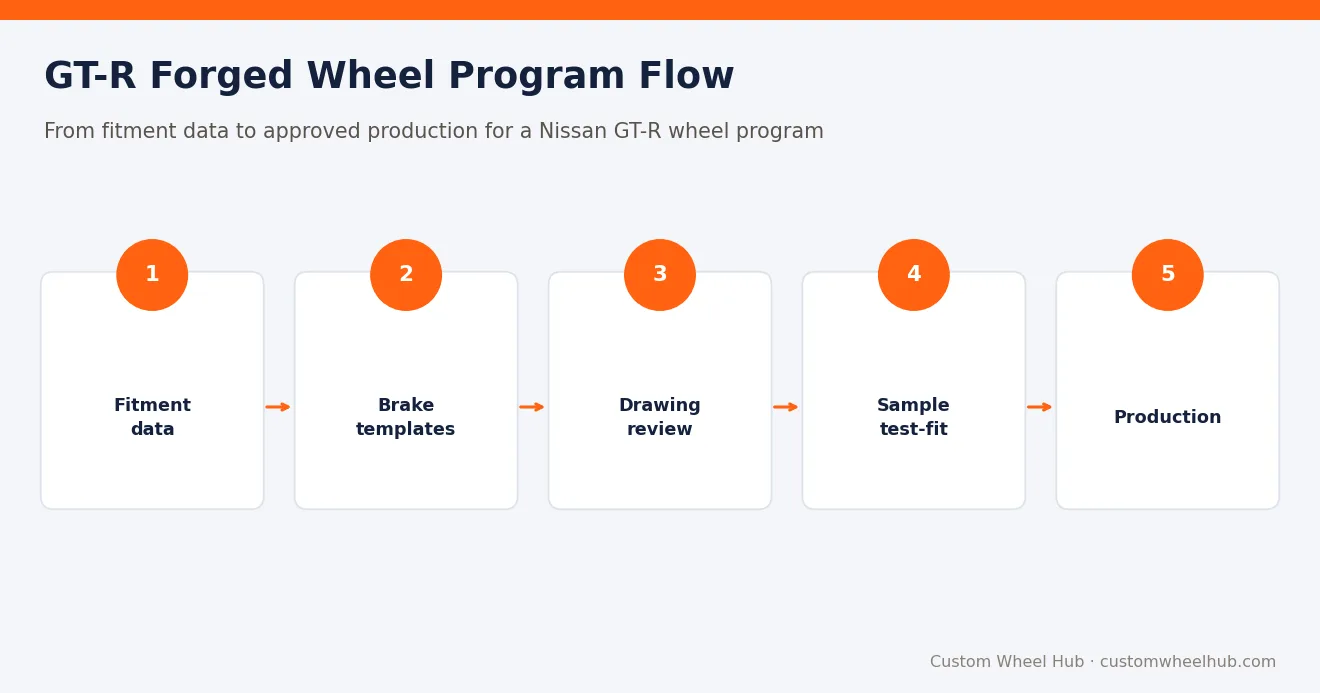
Drawings are approved first, then samples are produced and test-fit. Only after you approve the samples does mass production begin. Production timing, shipping route and Incoterms are confirmed in the written quotation, so you can plan your launch with agreed terms. Ask for protective packaging suited to machined and polished finishes during long transport.
Request a Quote for Nissan GT-R Forged Wheels
Prepare your target sizes, fitment data, brake setups to clear, preferred construction, finish, branding and estimated quantities. If you plan to resell to other shops, review our dealer and wholesale program as well.
Send your brief through the request a quote form, or contact us by email or WhatsApp. Our engineers review the data and reply with drawings and a written quotation.
Note: Vehicle names are used for fitment reference only; we are not affiliated with the manufacturers.
Frequently Asked Questions
Are forged wheels necessary for a high-power GT-R?
For high-power builds that see launches and track use, forged wheels are a common choice because they offer strength and stiffness at lower weight than most cast wheels. The right construction depends on how your customers drive, which our engineers discuss with you during drawing review before any samples are produced.
Do you publish GT-R bolt pattern and offset values?
No. We avoid publishing fixed fitment numbers for specific model years. Your fitment sheet or OEM data is verified and built into the drawing, which you approve before production. Our online calculators are useful for cross-checking, but the approved drawing is the final reference for every wheel we make.
Can you design wheels around aftermarket big brake kits?
Yes. Send templates, scans or detailed measurements of the brake kits your customers install. Our engineers check spoke profile and barrel clearance in the drawing, and test-fit samples confirm the result. Planning around aftermarket brakes from the start avoids redesigns after samples are made and reduces fitment complaints later.
Do you hold JWL or TÜV certification for GT-R wheels?
We explain JWL, VIA and TÜV as standards that buyers may require for their markets. If your program needs a specific standard, state it in your brief so it can be discussed during engineering review. Responsibility for any testing or approval route is agreed in writing as part of the quotation.
What is the minimum order for a GT-R wheel program?
MOQ is confirmed per project based on design, size, number of SKUs, finish and packaging. A launch with one design and one finish usually has a lower entry point than a broad range. Your written quotation states the MOQ along with production timing, shipping route and Incoterms.
Get a quick forged wheel quote
Send your vehicle platform, wheel size, PCD, offset, finish and quantity. We confirm fitment and reply within 24 hours.