Quick answer
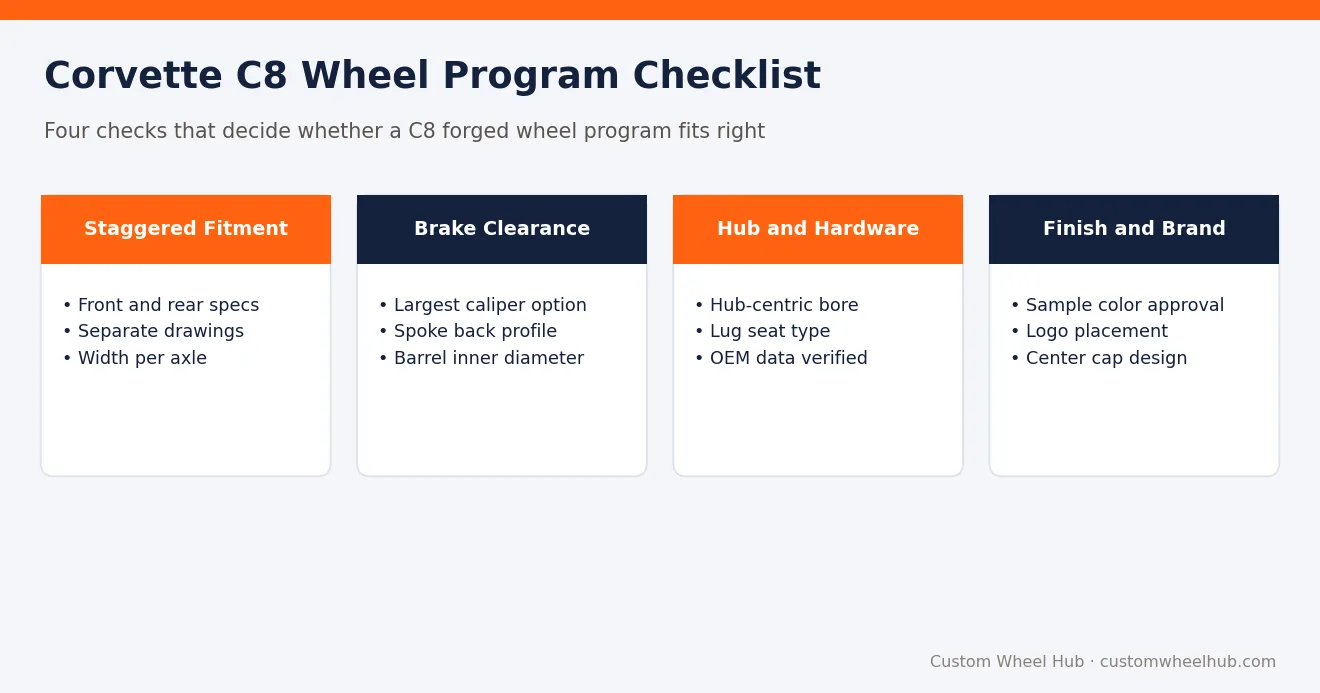
Corvette C8 custom forged wheels are built to a staggered front and rear specification taken from the buyer’s fitment sheet or verified OEM data. The key checks are caliper clearance for performance brake packages, hub-centric fit, lug seat type, and rear width. Monoblock suits most track and street builds, while 2-piece and 3-piece designs add finish and width flexibility for show programs.
The mid-engine Corvette C8 changed how wheel programs for this car are planned. Its staggered layout, large brake packages and low, wide stance mean a generic catalog wheel rarely delivers the look or the clearance that owners expect. Tuning shops and dealers selling upgrades need wheels engineered for the platform, not adapted to it.
This guide explains which fitment parameters matter on the C8, how to choose between monoblock and multi-piece construction, what to include in a request for quotation, and how drawing approval protects your program before production begins.
Why the Corvette C8 Needs a Platform-Specific Wheel Program
The C8 is sold to buyers who notice details. A wheel that sits slightly inboard, rubs a caliper under load or uses the wrong lug seat will generate returns and damage a shop’s reputation. Because the car is mid-engine and staggered from the factory, front and rear wheels behave as two different products with different widths, offsets and load paths.
For a wheel brand or distributor, this means planning the C8 as its own program with two part numbers per design at a minimum. Each needs its own drawing, its own clearance check and its own finish approval. Treating the platform as a single fitment is the most common reason early C8 wheel projects stall at the sample stage.
- Front and rear are engineered and approved separately
- Brake package variations change spoke clearance
- Trim-level differences are confirmed before drawings are issued
Key Fitment Parameters to Verify
We do not publish bolt patterns, offsets or center bore values for specific model years, because brake options and running changes make generic numbers unreliable. Instead, every C8 project starts from the buyer’s fitment sheet or OEM data, which is verified before drawing approval.
| Parameter | Why it matters on the C8 | How it is confirmed |
|---|---|---|
| PCD | Must match the hub exactly | Buyer fitment sheet, PCD calculator cross-check |
| Offset | Controls flush look and fender clearance front and rear | Measured target per axle, offset calculator |
| Center bore | Hub-centric fit reduces vibration at speed | OEM data, center bore calculator |
| Brake clearance | Performance calipers need spoke and barrel space | Caliper template or scan |
| Lug seat | Wrong seat type affects clamping | OEM hardware specification |
Staggered Setups and Width Planning
The C8’s staggered stance is part of its identity, and most aftermarket buyers want to keep or exaggerate it. That makes width and offset planning the center of the design discussion. A wider rear wheel can create more concave spoke depth, but only if the offset still keeps the tire inside the bodywork and away from suspension components.
When you brief a factory, give the target tire sizes you intend to sell, the desired visual position of the wheel face relative to the fender, and whether you want the same face design front and rear or a deeper rear profile. The engineering team then proposes widths and offsets for each axle, and your team confirms them on a test car before the drawing is signed.
- Define target tire sizes per axle
- Agree on visual position and concavity
- Review proposed width and offset per axle
- Test-fit samples and sign drawings
Brake Caliper Clearance on Performance Packages
Brake clearance is the single most important check on a C8 wheel. Performance brake packages use larger rotors and calipers, and the gap between the caliper face and the back of the spokes is often small. A design that clears one brake option may contact another.
The safest approach is to supply a caliper template, a 3D scan or clear measurements of the largest brake option your customers run. The factory then checks spoke profile, barrel inner diameter and any windowing or undercut in the drawing. If you plan to sell into shops that fit aftermarket big brake kits, include those kits in the brief as well, so the program covers the brakes your buyers actually use rather than only the factory setup.
Monoblock, 2-Piece or 3-Piece Construction
Most C8 programs choose forged monoblock wheels for their stiffness, low weight and clean appearance on track-focused and daily-driven cars. Monoblock designs are also simpler to repeat in volume because there is no assembly or hardware to manage.
Multi-piece wheels make sense for show builds, wide-body kits and customers who want unusual widths or two-tone finishes. A 2-piece or 3-piece construction lets you vary the barrel and lip while keeping one center design. The trade-off is more parts to specify, seal and inspect. For a detailed comparison, see our guide to 2-piece vs 3-piece vs monoblock forged wheels.
- Monoblock: track, street, clean volume programs
- 2-piece: wider width range with one face design
- 3-piece: maximum finish and lip customization
Finishes, Branding and Design Language
C8 owners tend to choose finishes that complement factory paint and carbon trim. Gloss black, satin bronze, brushed clear and two-tone machined faces are common requests, but your program can specify any finish the factory can reproduce consistently across batches.
Branding is part of the product. Custom center caps, engraved or laser-etched logos on the lip or spoke, and branded valve stems all help a distributor build recognition. Agree on logo placement early, because engraving positions can affect spoke thickness and finish masking. Samples are produced with the proposed finish and branding so you can judge color, gloss level and logo sharpness under real light before production starts.
MOQ, Samples and Production Planning
Minimum order quantity for a C8 program is confirmed per project, based on design, size, number of SKUs, finish and packaging. A single design in two sizes and one finish is easier to start than a range of faces in several finishes, so many buyers launch with a focused lineup and expand later.
Every project includes drawing approval and samples before production. Production timing, shipping route and Incoterms are confirmed in the written quotation, so your launch plan is based on agreed terms rather than estimates. Ask for packaging that protects machined faces and multi-piece hardware during long-distance freight.
- Confirm SKU count per axle and finish
- Approve drawings and samples
- Lock packaging and labeling before mass production
Request a Quote for Corvette C8 Forged Wheels
To receive an accurate proposal, send your target sizes per axle, fitment data or OEM reference, brake options to clear, preferred construction, finish, branding requirements and estimated quantities. You can also review our forged wheel products for design direction.
Submit your brief through the request a quote form, or contact us by email or WhatsApp. Our engineering team reviews your fitment data and replies with drawings and a written quotation.
Note: Vehicle names are used for fitment reference only; we are not affiliated with the manufacturers.
Frequently Asked Questions
Do you supply standard bolt patterns and offsets for the Corvette C8?
No. We do not publish fixed fitment numbers for specific model years because brake packages and running changes vary. Every project starts from the buyer’s fitment sheet or OEM data, which our engineers verify and reflect in the drawing. You approve that drawing before any production begins, so the final specification matches your cars.
Can one wheel design work front and rear on a staggered C8?
The face design can be shared, but the front and rear wheels are engineered as separate parts with their own width and offset. Many programs use a deeper concave profile on the rear to emphasize the stance. Each axle gets its own drawing, clearance check and sample approval before mass production.
Which construction is best for a track-focused C8 program?
Forged monoblock is usually preferred for track and performance street use because it offers a rigid, lightweight structure with no assembly hardware. Multi-piece wheels are better suited to show builds or wide-body kits. We discuss your use case and recommend a construction during the drawing stage.
How do you check clearance for big brake kits?
Send caliper templates, 3D scans or measured drawings of the brake setups your customers use. Our engineers check spoke profile, barrel inner diameter and caliper face clearance in the drawing. Test-fit samples are then confirmed on a vehicle before you approve production, reducing the risk of contact after launch.
What information should a Corvette C8 RFQ include?
Include target sizes per axle, fitment data, brake options, preferred construction, finish, branding details, packaging requirements and estimated quantities. The more complete the brief, the faster we can prepare drawings. MOQ, production timing, shipping route and Incoterms are confirmed in the written quotation we send back.
Get a quick forged wheel quote
Send your vehicle platform, wheel size, PCD, offset, finish and quantity. We confirm fitment and reply within 24 hours.