Quick answer
Volkswagen Golf R and GTI custom forged wheels are usually lightweight monoblock designs engineered from verified fitment data. Key checks include hub-centric fit, lug bolt seat type, brake caliper clearance for performance packages and aftermarket kits, and offset for flush fitment without rubbing. Square setups are common, and every specification is confirmed through drawing approval and samples.
The Golf R and GTI are among the most popular platforms in the hot hatch tuning scene. Owners care about weight, handling and a clean, flush look, and many take their cars to track days. For wheel brands and tuning shops, this is a market where small details such as lug bolt seat type and caliper clearance make a big difference.
This guide explains how to plan a Golf R and GTI forged wheel program, which fitment checks matter, how to approach weight and design, and how to prepare a request for quotation that leads to accurate drawings.
What Golf R and GTI Owners Expect
Hot hatch owners want wheels that are light, strong and visually sharp. Reduced unsprung weight improves steering response and ride quality, which buyers notice on a small, agile car. Many owners also use their cars on track days, so durability and brake cooling matter as well.
- Street styling: flush fitment, clean face designs, popular finishes
- Track days: light weight, brake clearance, wider tires
- Show builds: lowered cars, aggressive fitment, multi-piece options
Segmenting your program this way helps you choose sizes and designs that sell. A track-focused buyer may accept a simpler design for lower weight, while a show-build customer will prioritize visual depth and finish.
Many shops in this market also serve related performance hatchbacks and sedans, so a well-planned program can become the base for a wider range later.
Fitment Parameters to Verify
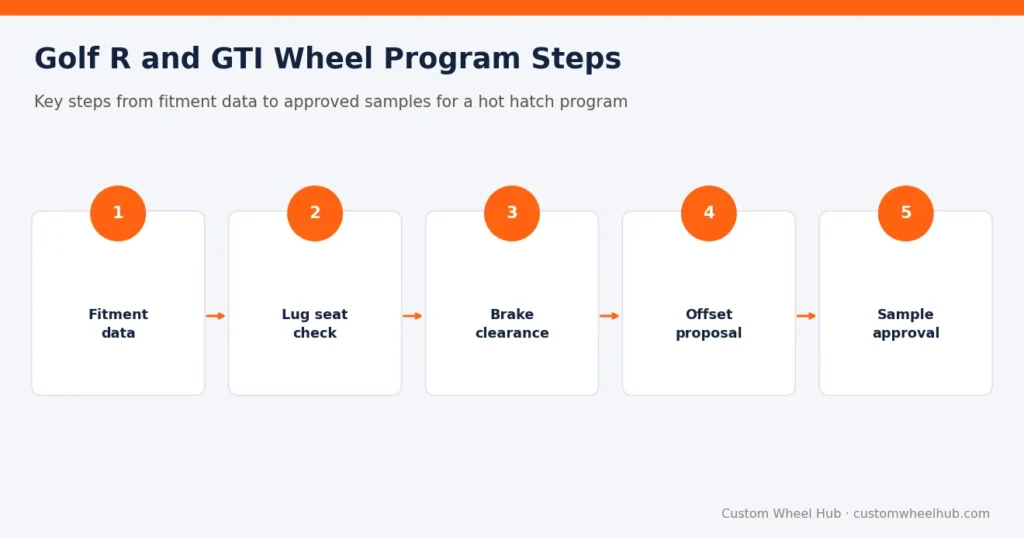
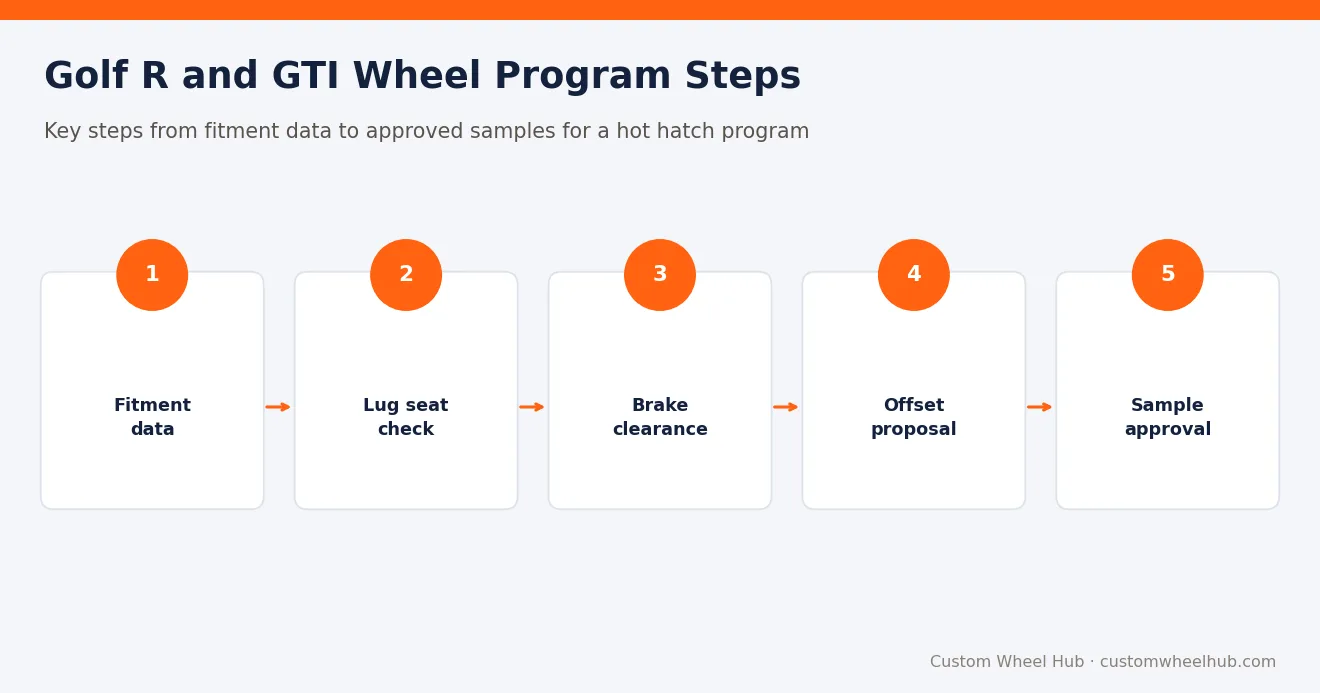
We do not publish exact bolt patterns, offsets or center bores for specific Golf model years. Generations and option packages vary, so your fitment sheet or OEM data is verified before drawing approval.
| Parameter | Golf R and GTI consideration | Verification |
|---|---|---|
| PCD | Confirm for each supported generation | PCD calculator and fitment sheet |
| Offset | Key to flush look without rubbing on lowered cars | Offset calculator |
| Center bore | Hub-centric fit reduces vibration | Center bore calculator |
| Brake clearance | Performance packages and big brake kits | Caliper template or scan |
| Lug seat | Lug bolts use a specific seat type | OEM hardware specification |
Lug Bolt Seat Type and Hardware
Like many European cars, the Golf uses lug bolts rather than studs and nuts. The seat type on the bolt must match the seat machined into the wheel. A mismatch can prevent correct clamping and is a common source of problems when owners switch from factory wheels.
Confirm the seat type in your fitment data, and decide whether your wheels will reuse factory bolts or ship with a specific hardware kit. If you supply hardware, include it in the brief so packaging and labeling cover it. Clear instructions about the correct bolts reduce installation errors at shops and help protect your brand.
- Confirm factory seat type from OEM data
- Decide on factory or supplied hardware
- Specify seat geometry in the drawing
- Label hardware requirements on the box
Brake Clearance for Performance Packages
Golf R models use larger brakes than standard models, and many owners fit aftermarket big brake kits for track use. A wheel that clears one setup may contact another, especially on smaller diameters favored for track tires.
Provide caliper templates or measurements for each brake setup you plan to support. Engineers check spoke backs, barrel inner diameter and undercut areas in the drawing, and test-fit samples confirm the result. Recording the approved brake setups on each drawing makes compatibility questions easier to answer later.
Brake cooling is another point for track buyers. Open spoke designs allow more airflow around the caliper and rotor during repeated hard stops. If your customers run track days, mention this in the brief so the design team can balance appearance, weight and airflow when shaping the spokes.
Weight, Strength and Design
Weight is a key selling point for hot hatch wheels, but it must not come at the cost of strength. Forged monoblock construction allows engineers to remove material where it is not needed while keeping stiffness in the spokes and hub area. Track-focused designs often use fewer, thinner spokes with careful pocketing behind the spoke faces.
Discuss the target use in your brief, as track use places different demands on a wheel than street use. Load considerations are reviewed during the drawing stage. If your market requires a standard such as JWL, VIA or TÜV, state it so testing responsibilities can be agreed in writing. Our guide to JWL, VIA and TÜV standards explains these requirements.
Square Setups, Lowered Cars and Offset
Most Golf R and GTI programs use square setups, which suit front-wheel-drive and all-wheel-drive hatchbacks and allow tire rotation. The main challenge is offset. Lowered cars with negative camber can tolerate more aggressive fitment, while stock-height cars need more conservative offsets to avoid rubbing.
Define which suspension setups you support and the target tire sizes. Engineering then proposes widths and offsets, and test-fit samples confirm clearance at full steering lock and under compression. Clear product descriptions about suspension requirements help shops advise customers correctly.
Hub-centric fit deserves attention here as well. If your wheels use a larger center bore to cover more than one platform, hub-centric rings are needed to center the wheel on the hub. Many hot hatch buyers prefer a wheel machined to the exact bore for their car, which avoids extra parts and the risk of lost rings. Decide which approach suits your program and state it in the brief, so drawings, hardware and packaging all reflect the same choice.
Finishes, Branding, MOQ and Samples
Popular hot hatch finishes include gloss black, satin bronze, gunmetal, silver and white for track styling. Machined lips and two-tone finishes are common for show builds. All finishes are approved on samples.
- Custom center caps and logos
- Engraved branding on spoke or lip
- Branded packaging and hardware kits
MOQ is confirmed per project by design, size, SKU, finish and packaging. Drawings and samples are approved before production, and production timing, shipping route and Incoterms are confirmed in the written quotation.
Request a Quote for Volkswagen Golf R and GTI Forged Wheels
Send the generations you support, target sizes, fitment data, lug bolt seat type, brake setups, suspension assumptions, finish, branding and estimated quantities. Browse our forged wheel products for design references.
Submit your brief through the request a quote form, or contact us by email or WhatsApp. Our engineers review your data and reply with drawings and a written quotation.
Note: Vehicle names are used for fitment reference only; we are not affiliated with the manufacturers.
Frequently Asked Questions
Why is lug bolt seat type important on the Golf?
The Golf uses lug bolts, and the seat on each bolt must match the seat machined into the wheel. A mismatch can prevent correct clamping. We confirm the seat type from your fitment data and specify it in the drawing, and we can include hardware requirements on packaging and labels.
Can you make lightweight track wheels for the Golf R?
Yes. Forged monoblock construction lets engineers reduce weight while keeping stiffness where it matters. Track-focused designs often use fewer spokes and careful pocketing. We review your intended use and load considerations during the drawing stage, and samples are approved before mass production begins.
Do you design around big brake kits?
Yes. Send templates, scans or measurements of the brake kits your customers use. Our engineers check spoke backs, barrel inner diameter and undercut areas in the drawing, and test-fit samples confirm clearance. Planning for aftermarket brakes from the start avoids redesigns and fitment complaints later.
Is a square setup best for the Golf R and GTI?
Square setups are the most common choice because they suit front-wheel-drive and all-wheel-drive hatchbacks and allow tire rotation. Offset is the main variable, and it depends on ride height and camber. We propose widths and offsets for your target setups and confirm them on test-fit samples.
What does an RFQ for a Golf program need?
Include supported generations, target sizes, fitment data, lug bolt seat type, brake setups, suspension assumptions, construction, finish, branding and estimated quantities. A complete brief leads to faster, more accurate drawings. MOQ, production timing, shipping route and Incoterms are confirmed in the written quotation we send.
Get a quick forged wheel quote
Send your vehicle platform, wheel size, PCD, offset, finish and quantity. We confirm fitment and reply within 24 hours.