Quick answer
Honda Civic Type R custom forged wheels are typically lightweight monoblock designs built from verified fitment data. The main checks are caliper clearance for the large factory brakes, offset choices that respect front-drive steering and scrub, hub-centric fit, lug seat type and tire width for track use. Square setups dominate, and drawings and samples are approved before production.
The Civic Type R is one of the most capable front-wheel-drive performance cars, and its owners take handling seriously. Many drive on track days, run sticky tires and look for every gram of weight saving. Wheels for this platform must clear large factory brakes, keep steering behavior predictable and stand up to hard use.
This guide is for tuning shops, distributors and wheel brands planning a Type R program. It explains the fitment checks that matter, how offset affects a front-drive car, how to approach weight and design, and how to prepare a request for quotation.
Who Buys Type R Wheels and Why
Type R buyers are usually enthusiasts. Some want a sharper look for the street, while many want lighter, wider wheels for track days and time attack events. Because the car already handles well from the factory, buyers expect any wheel upgrade to improve performance, not just appearance.
- Street: clean designs, flush fitment, factory-like comfort
- Track day: light weight, wider tires, brake clearance
- Time attack: maximum tire width, strength under high grip
A focused program with one or two strong designs often sells better than a broad catalog. Choose sizes that serve the street and track segments clearly, and explain which tire widths each size supports.
Type R owners also share information quickly in clubs and online forums. A wheel that fits well and performs on track gains a reputation fast, while a fitment problem spreads just as quickly, so careful engineering pays off in this market.
Fitment Parameters to Verify
We do not publish exact bolt patterns, offsets or center bores for specific Type R model years. Generations differ, so your fitment sheet or OEM data is verified before drawing approval.
| Parameter | Type R consideration | Verification |
|---|---|---|
| PCD | Confirm for each supported generation | PCD calculator and fitment sheet |
| Offset | Affects scrub radius and steering feel on a front-drive car | Offset calculator |
| Center bore | Hub-centric fit for smooth high-speed driving | Center bore calculator |
| Brake clearance | Large factory calipers sit close to spokes | Caliper template or scan |
| Lug seat | Must match OEM or aftermarket lug nuts | Hardware specification |
Brake Caliper Clearance
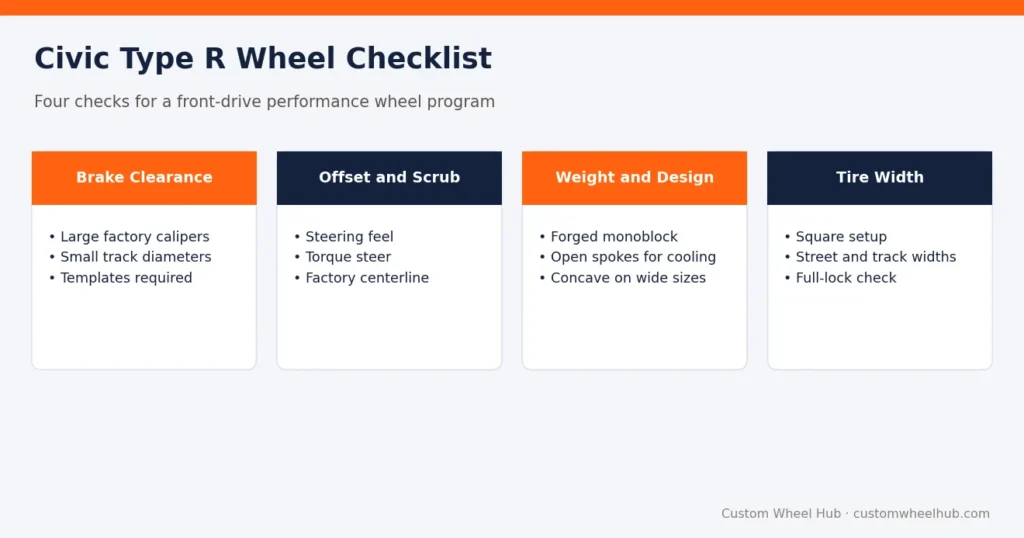
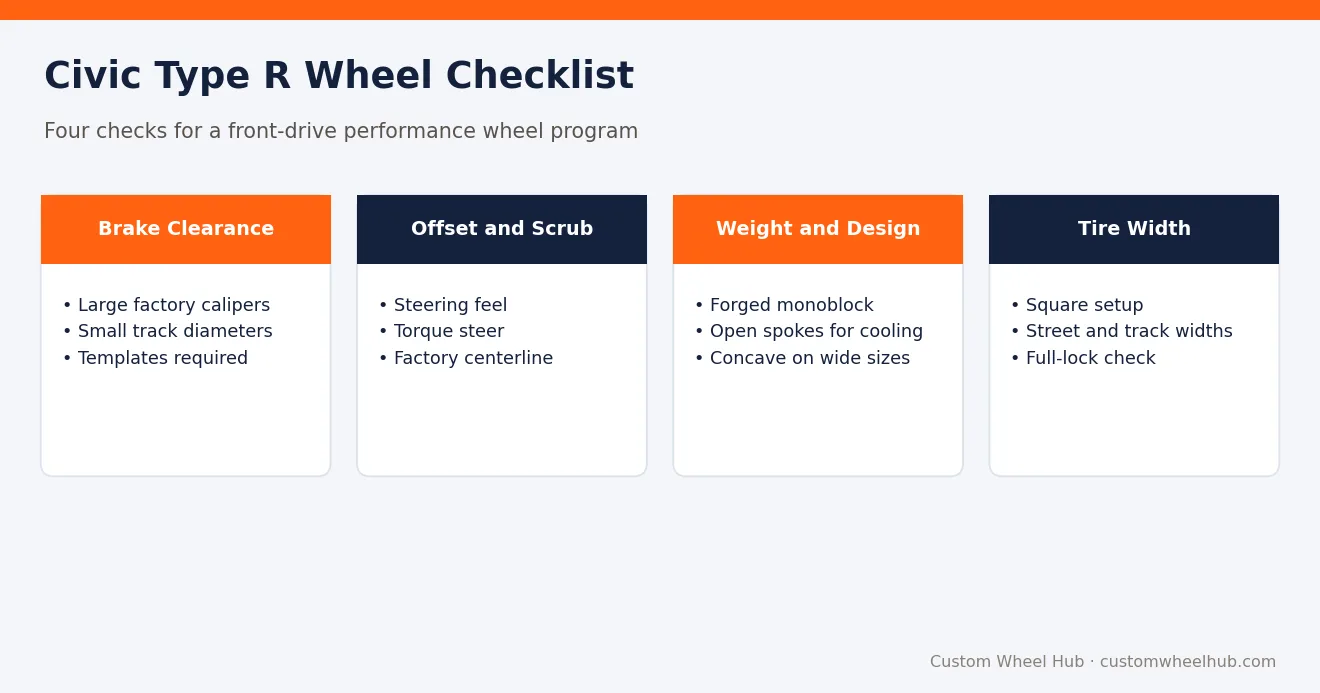
The Type R uses large multi-piston front calipers from the factory. Many attractive spoke designs do not clear them, especially on smaller diameters that track drivers like for tire choice and weight. Brake clearance is therefore the first engineering check on any Type R wheel.
- Supply caliper templates or measurements
- Include any aftermarket brake kits you support
- Review spoke profile and barrel diameter in the drawing
- Confirm clearance on test-fit samples
If you plan to offer a smaller diameter for track use, discuss it early. The design team may need to adjust the spoke shape or face profile to keep enough distance from the caliper while maintaining stiffness.
Offset and Front-Drive Handling
On a powerful front-wheel-drive car, offset affects more than appearance. It changes the scrub radius, which influences steering feel, torque steer and stability under braking. Moving the wheel too far outward can make the steering heavier and more sensitive to road surfaces, while keeping it close to factory geometry preserves the car’s balance.
Many track-focused programs choose a wider wheel with an offset that keeps the tire close to its factory centerline. Street programs sometimes prefer a slightly more flush look. Tell the engineering team which you prefer, along with target tire sizes and suspension setup, and they will propose widths and offsets for you to confirm on a test car.
Document the chosen approach on each drawing and in your product listings. Shops installing the wheels can then explain to customers how the new setup will feel compared with factory wheels, which builds trust and reduces complaints after installation.
Weight, Strength and Spoke Design
Forged monoblock wheels are the standard choice for this platform. They allow engineers to reduce weight while keeping stiffness in the spokes and hub area, which matters on a car that generates high cornering loads on sticky tires.
Spoke design shapes both looks and performance. Open designs help brake cooling on track, while concave faces add visual depth on wider sizes. Our guide to forged wheel concavity and spoke design explains how these choices interact. Load considerations are reviewed during the drawing stage, and if your market requires a standard such as JWL, VIA or TÜV, state it in the brief so responsibilities are agreed in writing.
Square Setups and Tire Width
Almost all Type R programs use a square setup. It allows tire rotation and suits the car’s front-drive layout, where the front tires do most of the work. The key question is how wide to go. Wider tires improve grip, but they need the right wheel width, offset and fender clearance.
Define the tire widths your customers want for street and track use. Engineering checks clearance at full steering lock and under suspension compression. Some aggressive setups need camber adjustment or fender work, so describe these requirements clearly in your product listings.
Keeping the number of widths small helps inventory planning. A street width and a track width for each diameter is often enough to cover most customers.
Finishes, Branding, MOQ and Samples
Type R owners often choose finishes that suit track styling: gloss white, bronze, matte black, gunmetal and silver are popular. Machined lips and accent colors can tie the wheel to factory paint and trim. All finishes are approved on physical samples.
- Custom center caps and spoke logos
- Lip engraving or laser marking
- Branded packaging for retail display
MOQ is confirmed per project by design, size, SKU, finish and packaging. Drawings and samples are approved before production, and production timing, shipping route and Incoterms are confirmed in the written quotation.
Packaging also deserves attention for a retail-focused market. Many Type R buyers collect wheels from a shop or receive them at home, so a clean, branded box makes a strong first impression and protects finished faces during shipping.
Request a Quote for Honda Civic Type R Forged Wheels
Send the generations you support, target sizes and tire widths, fitment data, brake setups, preferred offset approach, finish, branding and estimated quantities. Distributors can also review our dealer and wholesale program.
Submit your brief through the request a quote form, or contact us by email or WhatsApp. Our engineers review your data and reply with drawings and a written quotation.
Note: Vehicle names are used for fitment reference only; we are not affiliated with the manufacturers.
Frequently Asked Questions
Why is brake clearance such a concern on the Type R?
The Type R uses large multi-piston front calipers from the factory, and many spoke designs sit close to them, especially on smaller diameters. We check spoke profile and barrel diameter in the drawing using your caliper data, then confirm clearance on test-fit samples before production is approved.
How does offset affect a front-wheel-drive car?
Offset changes the scrub radius, which affects steering feel, torque steer and braking stability. Pushing the wheel too far outward can make steering heavier and more sensitive. Our engineers propose offsets based on your tire sizes and suspension setup, and you confirm the result on a test vehicle.
Do you publish Type R bolt pattern and offset numbers?
No. We do not publish fixed fitment values for specific model years. Your fitment sheet or OEM data is verified and built into the drawing, which you approve before any production. Our online calculators are useful for checking, but the approved drawing is always the final reference.
Can you make wheels for time attack and track use?
Yes. We engineer lightweight forged monoblock wheels for track use, based on your fitment data, tire width and brake setup. Load considerations are reviewed during the drawing stage. Test-fit samples confirm clearance at full lock and under compression before you approve mass production.
What should a Type R RFQ include?
Include supported generations, target sizes and tire widths, fitment data, brake setups, preferred offset approach, construction, finish, branding and estimated quantities. A complete brief speeds up drawings. MOQ, production timing, shipping route and Incoterms are confirmed in the written quotation we send back to you.
Get a quick forged wheel quote
Send your vehicle platform, wheel size, PCD, offset, finish and quantity. We confirm fitment and reply within 24 hours.