Quick answer
Silverado and Sierra custom forged truck wheels are engineered around truck loads, towing and the buyer’s verified fitment data. Light-duty and heavy-duty versions must be treated as separate fitments, with checks for PCD, offset, center bore, lug seat type and brake clearance. Programs often combine forged flagship designs with cast volume lines, all approved through drawings and samples.
The Silverado and Sierra share much of their engineering, which makes them an attractive pair for truck wheel programs. One design can often be offered across both trucks, while trim-specific finishes help match each brand’s styling. However, light-duty and heavy-duty versions differ in ways that matter greatly for wheels.
This guide is for truck wheel brands, dealers and accessory shops. It explains how to structure a program across both trucks, which fitment and load checks matter, how to choose diameters, construction and finishes, and what to include in a request for quotation.
One Platform, Two Brands, Several Duty Levels
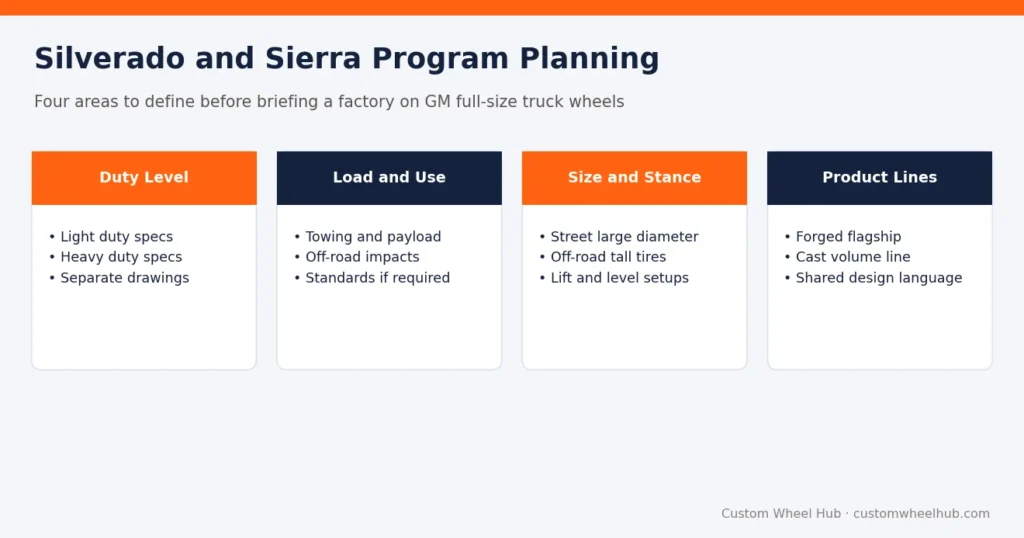
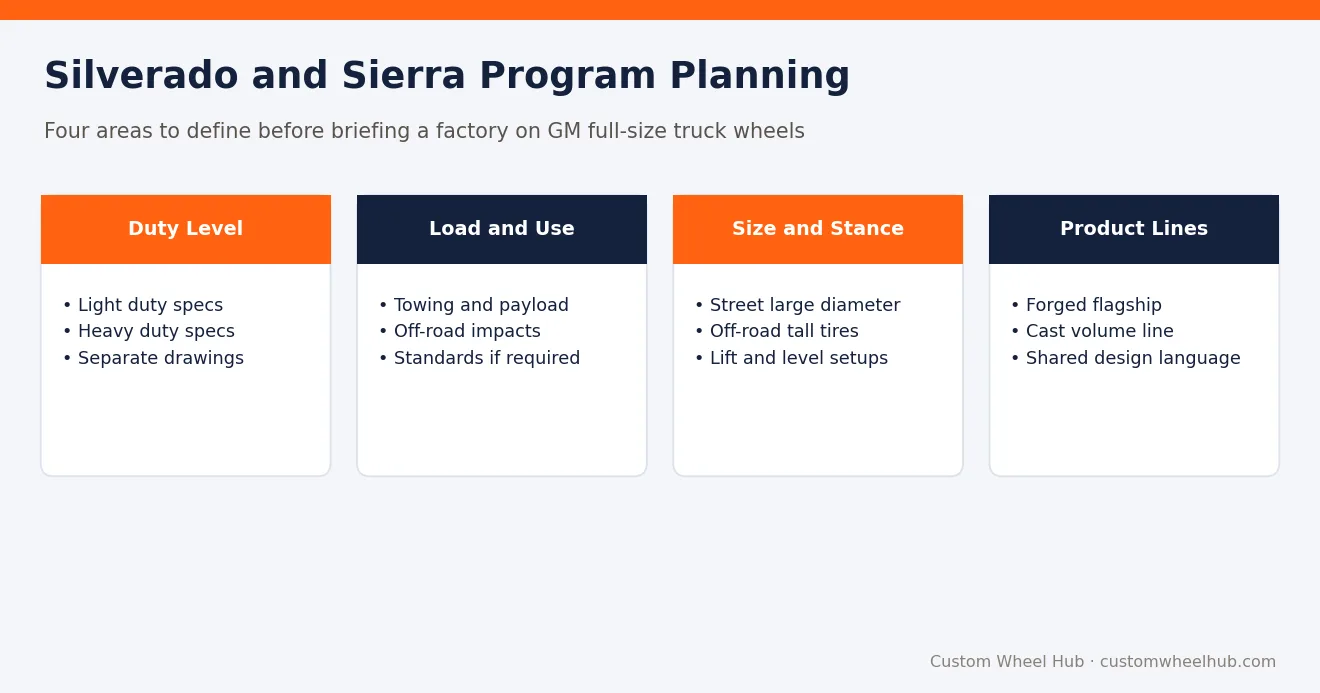
Because the Silverado and Sierra are closely related, a wheel program can often share designs between them. This is efficient for inventory and marketing. The bigger difference is duty level. Light-duty half-ton trucks and heavy-duty trucks use different hubs, brakes and load requirements, so they are separate fitments even when the body looks similar.
- Light duty: street, family use, moderate towing, larger diameters popular
- Off-road trims: taller tires, matte finishes, off-road strength
- Heavy duty: serious towing and payload, separate engineering
- Premium trims: polished or chrome-look finishes, dealer upgrades
Decide early which duty levels and trims you will support. Each needs verified fitment data, its own drawing and its own sample approval. Clear labeling by duty level also prevents costly mix-ups at the warehouse and at the dealer service desk.
Load, Towing and Payload Considerations
Truck wheels must carry payload, trailer tongue weight and accessories while handling potholes, gravel roads and off-road impacts. A heavy-duty program faces much higher loads than a light-duty program, and the wheel design must reflect that.
State the intended use in your brief, including towing and payload expectations. Our engineers review load considerations during the drawing stage, including spoke cross-section, mounting pad thickness and rim profile. We do not publish load ratings. Standards such as JWL and VIA are explained as requirements that buyers may need in their markets; if you need one, state it in the brief so responsibilities are agreed in writing.
Heavy-duty programs also deserve attention to hardware. Lug seat type, stud length and hub-centric fit should all match OEM data so the wheel clamps correctly under load.
Fitment Parameters to Verify
We do not publish exact bolt patterns, offsets, center bores or tire sizes for specific model years. Your fitment sheet or OEM data is verified before drawing approval.
| Parameter | Silverado and Sierra consideration | Verification |
|---|---|---|
| PCD | Light and heavy duty differ | PCD calculator and fitment sheet |
| Offset | Affects stance, scrub and fender clearance | Offset calculator |
| Center bore | Hub-centric fit is essential under truck loads | Center bore calculator |
| Brake clearance | Large truck calipers need space | Caliper template or scan |
| Lug seat | Must match truck lug nut hardware | Hardware specification |
Diameter, Tire Size and Lift Planning
Silverado and Sierra owners customize in two main directions. Street builds often move to larger diameters with lower-profile tires. Off-road builds use smaller diameters with taller all-terrain tires, often paired with leveling or lift kits.
- Choose diameters for each customer segment
- Set target tire sizes for stock, leveled and lifted trucks
- Agree on stance: OEM-like, flush or poke
- Review engineering proposals for width and offset
- Approve drawings and test-fit samples
Wider wheels with more aggressive offset may require fender trimming or flares. Be clear in your product descriptions about which setups fit without modification, so dealers can advise customers accurately and avoid returns.
Brake Clearance and Spoke Design
Full-size trucks use large brake calipers, and heavy-duty trucks use even larger ones. Spoke design and barrel inner diameter must be checked against every brake setup you support, especially on smaller off-road diameters.
Provide caliper templates, scans or measurements. Engineers check spoke backs and any undercut in the drawing, then confirm clearance on test-fit samples. Deep concave designs need extra care because they bring the spoke closer to the caliper. Recording the approved brake reference on each drawing also helps your team answer compatibility questions quickly.
Forged and Cast Product Lines
Many truck wheel brands use a two-level approach. Forged monoblock wheels serve flagship designs, premium trims and off-road builds where strength and lower weight matter. Cast alloy wheels support high-volume dealer programs where cost and availability are priorities.
Multi-piece forged wheels are popular in the show-truck scene, especially in large diameters with polished lips. Keep design language consistent across lines so customers recognize your brand. For more on the differences between processes, see forged vs flow-formed vs cast wheels.
Off-road designs may include simulated beadlock rings for a rugged look. Make sure your product descriptions explain the difference between simulated and true beadlocks, so customers understand what they are buying.
Finishes, Branding and Production Planning
Finishes for these trucks often follow trim packages. Chrome-look and polished faces suit premium trims, gloss and satin black suit sport packages, and matte or textured finishes suit off-road trims. All finishes are approved on physical samples.
- Confirm center caps and logo designs
- Agree on heavy-duty packaging for large wheels
- Lock labeling by duty level and trim
MOQ is confirmed per project by design, size, SKU, finish and packaging. Production timing, shipping route and Incoterms are confirmed in the written quotation, so dealers can plan stock with agreed terms.
Reorders deserve planning too. Truck owners often return for a second set for winter tires or a trailer setup, and dealers want the finish to match the original. Keeping approved samples on file and confirming finish codes in every order helps later batches match earlier ones. Agree on how small reorders for popular sizes will be handled, so dealers can keep core stock available without carrying large amounts of slow inventory.
Request a Quote for Silverado and Sierra Forged Wheels
Send the duty levels, trims and years you support, target sizes, fitment data, load and towing expectations, brake setups, construction, finish, branding and estimated quantities. Dealers can review our dealer and wholesale program.
Submit your brief through the request a quote form, or contact us by email or WhatsApp. Our engineers review your data and reply with drawings and a written quotation.
Note: Vehicle names are used for fitment reference only; we are not affiliated with the manufacturers.
Frequently Asked Questions
Can one wheel design fit both the Silverado and the Sierra?
Often yes for the same duty level, because the trucks share much of their engineering. Each supported version is still checked against verified fitment data, and finishes can be adapted to suit each brand’s trims. Drawings and test-fit samples confirm the final specification before any production begins.
Are heavy-duty truck wheels different from light-duty wheels?
Yes. Heavy-duty trucks use different hubs, brakes and load requirements, so they are separate fitments with separate engineering. We review load considerations for your intended use during the drawing stage. If your market requires a standard such as JWL or VIA, state it so responsibilities are agreed in writing.
Do you publish bolt patterns and tire sizes for these trucks?
No. We do not publish fixed fitment values or tire sizes for specific model years. Your fitment sheet or OEM data is verified and reflected in the drawing, which you approve before production. Our online calculators help with cross-checking, but the approved drawing is the final reference.
Should a truck wheel brand offer both forged and cast wheels?
Many do. Forged wheels serve flagship designs, premium trims and off-road builds, while cast wheels support volume dealer programs. A consistent design language across both lines helps customers recognize the brand. We can advise which designs suit each construction type when you send your program brief.
How should lifted and leveled trucks be handled in the program?
Include the lift and leveling setups your customers use in the brief, along with target tire sizes. Our engineers propose widths and offsets for each setup, and test-fit samples confirm clearance. Clear product descriptions about which setups need trimming or flares help dealers advise customers and reduce returns.
Get a quick forged wheel quote
Send your vehicle platform, wheel size, PCD, offset, finish and quantity. We confirm fitment and reply within 24 hours.