
Quick answer: A forged wheel load rating is a specification for the exact wheel design, size and application. JWL, VIA and TÜV are not interchangeable labels. JWL/JWL-T relate to Japanese technical standards and manufacturer self-certification; the VIA mark requires registration after verification testing through the Japanese council system. “TÜV” may refer to a testing organization, report or approval route, so buyers must ask for the exact standard, report number, wheel scope and destination-market relevance.
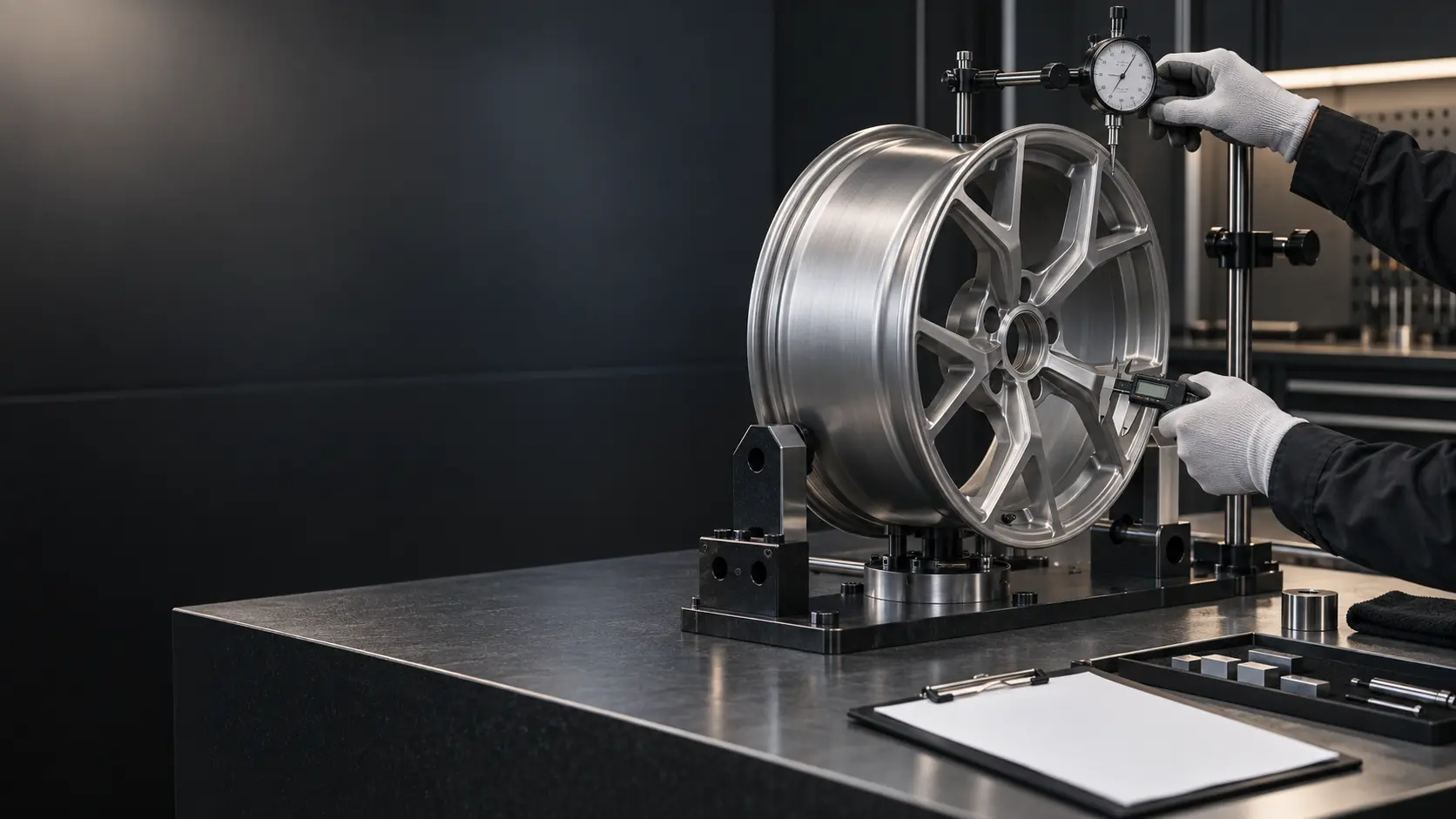
Load Rating, Test Standard and Approval Are Three Different Things
| Item | What it answers | What it does not prove by itself |
|---|---|---|
| Wheel load rating | The stated maximum load basis for a defined wheel | That the wheel fits every vehicle below that number |
| Test report | What specimen was tested, how and with what result | That every size/design/offset is automatically covered |
| Registration/certificate | That a defined product/scope was registered or certified under a scheme | Universal legality or coverage outside the stated market/scope |
| Wheel marking | What the manufacturer declares or is permitted to mark | Authenticity without traceable supporting records |
| Vehicle fitment approval | That a wheel/application combination is accepted under a defined route | Suitability for another chassis, tire or brake package |
How to Set the Load Requirement
Start with the exact vehicle, front and rear axle data, intended loading and destination requirements. Do not rely on GVWR divided by four as a universal rule because axle loads may not be equal. In U.S. vehicle regulations, 49 CFR 571.110 ties maximum tire loads to axle distribution and, for covered trucks and multipurpose passenger vehicles, requires the sum of tire ratings on an axle to meet GAWR. Heavy-vehicle requirements are addressed separately in 49 CFR 571.120.
- Record vehicle make, model, year, trim, market and axle position.
- Obtain front/rear GAWR or equivalent manufacturer data for the exact vehicle.
- Include cargo, towing, accessories and intended on-road/off-road use within vehicle limits.
- Define tire, wheel and vehicle requirements as a system.
- Agree the wheel’s stated load, test standard, marking and document scope before design freeze.
- Match the final report/registration to the produced part number, size, design and load.
JWL and JWL-T
The Japan Light Alloy Automotive Wheel Testing Council explains that Japan’s Ministry of Land, Infrastructure, Transport and Tourism established technical standards for light-alloy wheels. JWL applies to passenger-car wheels and JWL-T to truck and bus wheels. The council describes these marks within a manufacturer self-accreditation framework after the applicable tests are met.
VIA Registration
VIA is a separate voluntary registration system administered through the Japanese council structure. The council states that verification testing and assessment are required and that only registered products may carry the VIA mark. A factory’s ability to perform a test does not by itself authorize use of the VIA mark.
For every VIA claim, ask for the registration record and match wheel design, size, PCD/load conditions and marking to the purchase specification. Never accept a VIA logo copied into artwork as evidence.
What Buyers Usually Mean by “TÜV Certified Wheels”
The phrase is incomplete. TÜV organizations provide automotive component testing and related services, but a buyer needs the specific deliverable: test report, parts approval, type-approval evidence or another market route. Ask which TÜV entity issued it, which standard was used, what wheel variants are covered, what vehicle applications are listed and whether the document remains valid for the destination.
For European replacement-wheel projects, UN Regulation No. 124 is one relevant approval framework for defined vehicle categories and replacement-wheel scope. National registration or approval practice can add requirements, so the importer should confirm the route for each market.
Document Cross-Check Table
| Field | Must match | Red flag |
|---|---|---|
| Applicant/manufacturer | Legal entity involved in the wheel program | Certificate holder is unrelated or unexplained |
| Wheel identification | Part number, model/design family and marking | Only a marketing name is shared |
| Dimensions | Diameter, width and relevant fitment variants | Report covers one size but quote lists many |
| Load/test condition | Stated load and application/test condition | A higher marketing load than the report |
| Material/construction | Wheel type and controlled construction | Different piece count or material condition |
| Standard/version | Exact referenced standard and revision | Only “JWL/VIA/TÜV passed” appears |
| Dates/status | Issue date, validity/registration status and revisions | Expired, superseded or unverifiable copy |
| Marking | Permitted logo, load, size and traceability format | Artwork prepared before scope is confirmed |
Supplier Questions Before Production
- What wheel load will appear on the approved drawing and wheel?
- Which vehicle/axle data was used to set it?
- Which exact test standard and revision apply?
- Is the evidence a manufacturer test, independent lab report, registration or type approval?
- Which sizes, offsets, PCDs, constructions and design variants are included?
- Who is the applicant, manufacturer and report/certificate holder?
- Can the registration or report identity be independently checked?
- What change to design, material, load or production requires re-evaluation?
Read the existing JWL, VIA and TÜV certification guide for the market overview, then use the forged wheel supplier checklist to connect documents to the quoted SKU.
Sources and verification notes
- Japan Light Alloy Automotive Wheel Testing Council — Marking Q&A — official explanation of JWL/JWL-T and VIA registration/mark use
- 49 CFR 571.110 — U.S. tire/rim and axle-load context for covered vehicles at or below 10,000 lb GVWR
- 49 CFR 571.120 — U.S. tire/rim and marking context for vehicles above 10,000 lb GVWR
- EUR-Lex — UN Regulation No. 124 — replacement-wheel approval framework for its defined scope
Frequently Asked Questions
Does a JWL mark mean the wheel is VIA registered?
No. The Japanese council distinguishes JWL/JWL-T manufacturer self-accreditation from VIA third-party verification and registration.
Can one test report cover every size and offset?
Only if the report or approval scope explicitly includes them under its rules. Match every quoted variant to the evidence.
Is a TÜV test report valid everywhere in Europe?
Do not assume so. The exact report, approval route, vehicle application and national requirements determine how it can be used.
Verify Load and Documents Against One Wheel SKU
Send the vehicle/axle application, wheel construction, size, PCD, offset, target load, destination market and required test or approval. We can organize a document checklist for the exact quoted wheel before markings are approved.