
Quick answer: Forged wheels usually suit premium, low-to-medium-volume and fitment-specific programs; flow-formed wheels can balance lower mass and volume economics by forming the barrel of a cast preform; cast wheels usually offer the lowest entry cost for stable, higher-volume designs. None of these labels alone proves that a wheel is safe, light or strong. Compare the approved design, material specification, load rating, test scope, quality control and quotation on the same fitment.
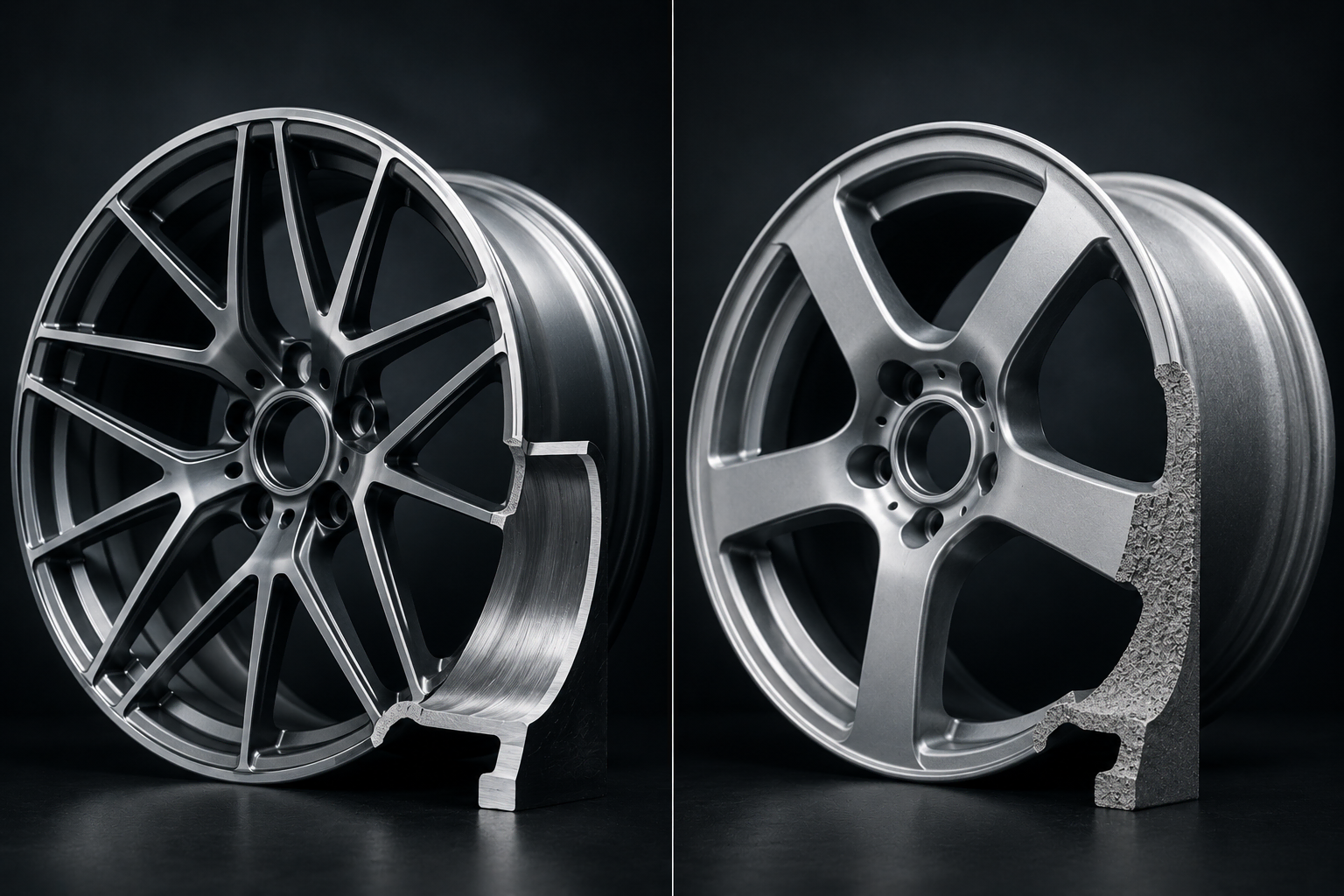
Forged vs Flow-Formed vs Cast: Buyer Comparison
| Decision area | Forged | Flow-formed | Cast |
|---|---|---|---|
| Basic route | Forged blank is machined into the final wheel geometry | Cast preform is made, then the rim barrel is formed under controlled pressure and rotation | Molten alloy is cast into a wheel mold, then machined and finished |
| Best commercial fit | Premium, custom, low-to-medium-volume and vehicle-specific programs | Mid-market performance ranges with repeatable sizes and meaningful volume | Price-sensitive, stable and higher-volume aftermarket ranges |
| Fitment flexibility | High for custom diameter, width, PCD, center bore, offset and brake package | Usually tied to available preforms, tooling and planned size families | Usually tied most closely to mold and tooling choices |
| Unit-cost tendency | Higher | Middle | Lower at suitable volume |
| Tooling/engineering focus | Blank selection, CAD, machining, finish and validation | Casting/preform, forming parameters, machining, finish and validation | Mold, casting process, machining, finish and validation |
| Main sourcing risk | Paying a premium without receiving project-specific engineering evidence | Assuming every part of the wheel receives the same forming benefit | Choosing by price without controlling porosity, process, geometry and test scope |
What “Forged” Changes—and What It Does Not
Forging changes how the starting aluminum blank is produced and worked before machining. It can support efficient structural design, but the final result still depends on the wheel section, heat-treatment condition, machining strategy and validation. Buyers should request the alloy and temper, blank traceability, approved drawing, stated wheel mass and applicable inspection or test documents for the exact part number.
A custom forged wheel program is especially useful when the vehicle, brake package, offset or brand design cannot be served well by a fixed catalog. See the custom forged wheel program for the specification inputs used before quoting.
How Flow Forming Fits Between Forging and Casting
Flow forming begins with a cast preform. The rim section is then formed by rollers while the preform rotates, changing the barrel geometry and material flow. This can create a commercially attractive middle position, but buyers should avoid treating “flow-formed” as a universal quality grade. Confirm which sections are flow formed, what design and load target applies, and whether the exact SKU is covered by the supplier’s test evidence.
When Cast Wheels Are the Rational Choice
Casting can be the correct choice for a price-led, repeatable product line with sufficient volume. The commercial advantage comes from spreading mold and setup cost across more wheels. Its limitations appear when a buyer needs frequent fitment changes, many low-volume SKUs or highly variable offsets. A low quoted unit price can become less attractive after tooling, minimums, inventory and slow-moving variants are included.
Compare Cost on the Same Scope
- Use the same diameter, width, PCD, center bore, offset and brake-clearance requirement.
- State whether the quote is per wheel, per set or per complete production batch.
- Separate tooling, engineering, sample, finish, logo, center-cap and packaging charges.
- Ask for wheel mass as a project target or drawing value, not a generic process claim.
- Match the required load rating, test standard and documentation scope.
- Calculate landed cost and inventory exposure across the full SKU plan.
Decision Matrix by Buyer Type
| Buyer situation | Likely starting point | Reason to investigate another process |
|---|---|---|
| Bespoke tuning shop with varied vehicle builds | Forged | Move to flow-formed only when repeatable size families and volume justify it |
| Emerging premium private-label brand | Forged or flow-formed | Use cast only after the fitment range and volume are stable enough for tooling |
| Regional distributor focused on entry price | Cast or flow-formed | Add forged as a halo/custom line rather than forcing one process across the catalog |
| Motorsport or big-brake project | Project-specific forged review | Do not select by process name; require engineering and test evidence for the actual application |
Supplier Evidence to Request
- Material and temper for the exact SKU or approved production drawing.
- Drawing with dimensions, tolerances, wheel mass target and load marking.
- Process flow identifying casting, forging, forming, heat treatment, machining and finishing stages that apply.
- Inspection plan for dimensional checks, runout, finish and marking.
- Test report or approval whose part number, size, load and design scope match the wheel being purchased.
- Commercial breakdown for tooling, sample, unit price, packaging and repeat orders.
For a deeper two-way comparison, read Forged vs Cast Wheels. Then use the supplier checklist to verify that the quotation and supporting documents refer to the same wheel.
Frequently Asked Questions
Are flow-formed wheels forged?
No. Flow forming normally starts from a cast preform and forms the rim section. It should be described as its own manufacturing route, not as a fully forged wheel.
Are forged wheels always lighter than cast wheels?
Not automatically. Weight depends on the complete design, size, load target, material condition and required margins. Compare exact drawings or approved specifications.
Which process has the lowest MOQ?
MOQ is supplier- and project-specific. Forged machining may support small custom batches, while cast and flow-formed programs can depend more heavily on tooling, preforms, finish batches and planned volume.
Compare Three Processes on One Wheel Brief
Send one target fitment, expected annual volume, required finish, branding, documentation and destination. We can structure the discussion around the same scope so the forged, flow-formed or cast recommendation is commercially comparable.